
On the Congress That Would Not Do Its Duty
I am a lawyer. I have always been a lawyer. Before I was a revolutionary, before I was a diplomat, before I was president, I was a man who believed that the law was the only thing standing between civilization and the abyss. I defended British soldiers when the mob wanted them hanged, not because I loved the Crown but because I loved the principle that even the despised are entitled to a fair hearing before the facts. “Facts are stubborn things,” I told the jury in that Boston courtroom, “and whatever may be our wishes, our inclinations, or the dictates of our passion, they cannot alter the state of facts and evidence.”
I offer that preamble because the facts of this present matter are not in dispute, and I intend to prosecute the case against those who would prefer to ignore them.
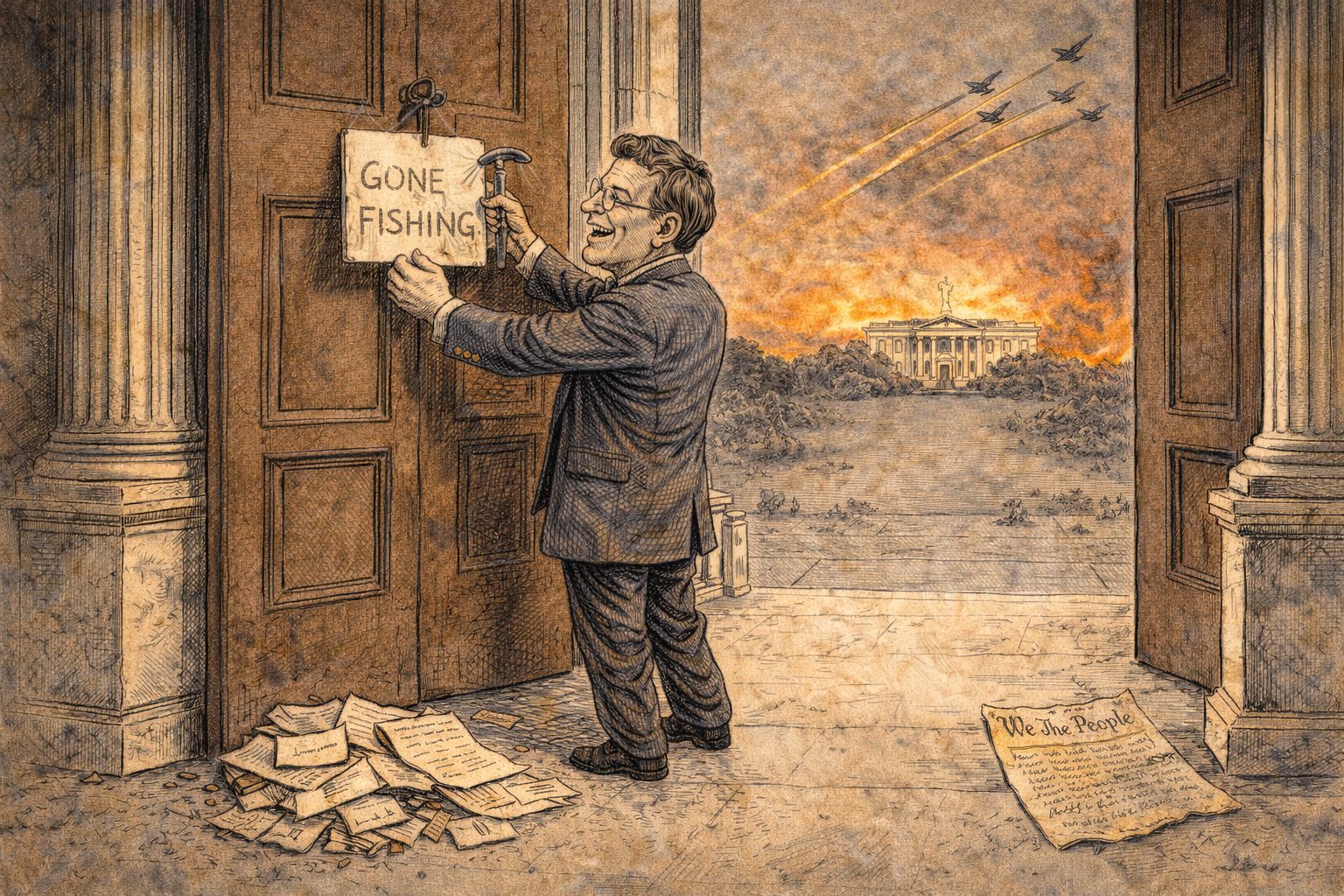
On the twenty-eighth of February, 2026, the President of the United States ordered military strikes against the sovereign nation of Iran. He did so without a declaration of war from Congress. He did so without a specific authorization for the use of military force. He did so, in point of law, without the constitutional authority to do so. These are not opinions. These are facts. They are stubborn. And they will not yield to the passions of the hour.
My colleagues have written with great force on the moral dimensions of this war. Mr. Paine has named it tyranny, which is his prerogative and his talent. Mr. Madison has diagnosed the structural failure of the Republic’s institutions, which is his particular genius. I commend both essays to your attention.
But I am not a pamphleteer, and I am not an architect. I am an attorney. And what I see before me is a crime.
Not a metaphorical crime. Not a rhetorical crime. A legal one. Article One, Section Eight of the Constitution of the United States grants to the Congress, and to the Congress alone, the power to declare war. The War Powers Resolution of 1973, enacted into law over a presidential veto, requires that the President consult with Congress before introducing United States Armed Forces into hostilities, report to Congress within forty-eight hours of doing so, and withdraw those forces within sixty days absent a congressional declaration of war or specific authorization.
The President consulted no one. He notified the Gang of Eight, a select group of congressional leaders, shortly before the strikes commenced. Notification is not consultation. Informing a man that you have set fire to his house is not the same as asking his permission to light the match.
He then announced the commencement of hostilities not to the Congress, not to the nation assembled, but in a video posted to a social media platform, as though the decision to send American men and women to kill and die were of no greater constitutional moment than an endorsement of a commercial product.
And now, eleven days into a war that no one in Congress voted to authorize, the ledger reads as follows: eight American service members dead, including six Army reservists killed by a drone strike in Kuwait and a Space Brigade sergeant who died of injuries sustained in Saudi Arabia. Over twelve hundred Iranians dead, including more than two hundred children. Between one hundred and sixty-five and one hundred and eighty schoolgirls killed in a single strike on a school in Minab. Thirteen health facilities struck. UNESCO World Heritage Sites in Isfahan damaged, including Naqsh-e Jahan Square and the Shah Mosque. The Strait of Hormuz effectively closed. Oil above one hundred dollars a barrel. Global markets in freefall. Hezbollah launching retaliatory strikes from Lebanon. Iranian missiles hitting American bases in Qatar, Bahrain, Kuwait, Iraq, Jordan, Saudi Arabia, and Turkey. A British air base on Cyprus struck by a drone. And Iran has named the dead Supreme Leader’s son as his successor, signaling not capitulation but continuation.
The President told the nation this would last “four to five weeks,” as though war were a renovation project with a contractor’s estimate. He has since demanded Iran’s “unconditional surrender.” These two statements cannot both be true, and a lawyer notes that neither was submitted to the Congress for its consideration.
Let me be precise about the law, for precision is what distinguishes governance from caprice. The War Powers Resolution does not grant the President authority to wage war for sixty days and then seek permission. It requires consultation before the introduction of forces into hostilities. It requires a report within forty-eight hours. It requires the withdrawal of forces within sixty days unless Congress has acted. The sixty-day provision is a constraint, not a license. It was enacted specifically to prevent what has now occurred: a president committing the nation to war and then daring Congress to stop him.
The current president has treated it as a license. Every president since Nixon has treated it as a license. And every Congress since 1973 has permitted them to do so, which brings me to the heart of my indictment.
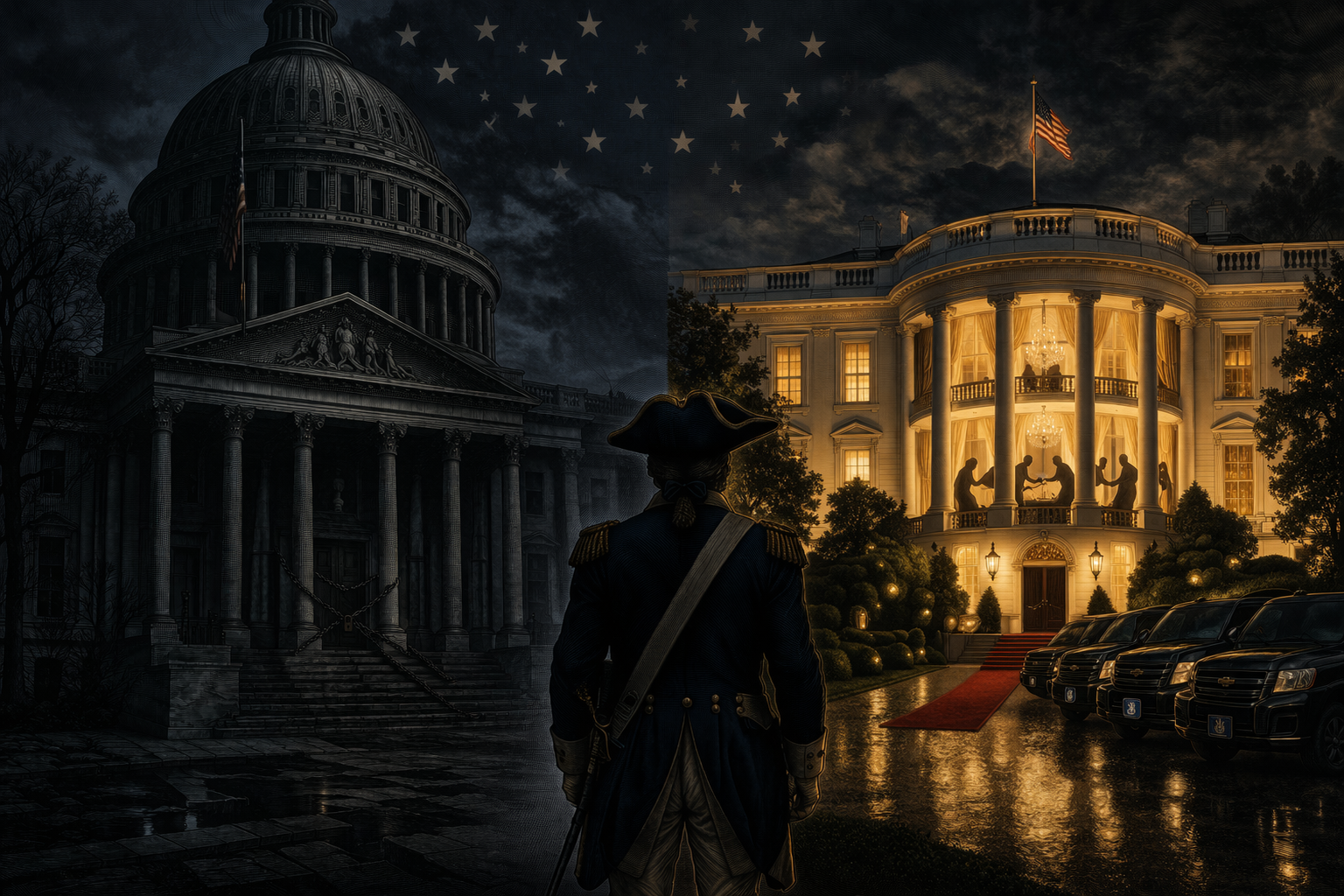
The crime is not the President’s alone. The greater crime, the one that will echo through the centuries, belongs to the Congress.
Let me speak now not of what I anticipated but of what occurred, for the votes have been taken and the record is complete. The client, in this instance, is the Republic, and the verdict has been rendered.
On Wednesday, March the fourth, the Senate voted forty-seven to fifty-three to reject the war powers resolution introduced by Senator Tim Kaine of Virginia and co-sponsored by Senator Rand Paul of Kentucky. The resolution would have required the withdrawal of American forces from hostilities against Iran unless Congress explicitly authorized their use. It did not prevent the defense of American personnel. It did not prohibit intelligence sharing with allies. It did the one thing the Constitution requires: it demanded that the people’s representatives vote on whether this nation shall be at war.
Forty-seven senators voted for their constitutional duty. Fifty-three voted against it. The margin of betrayal is a matter of public record.
On Thursday, March the fifth, the House voted two hundred and twelve to two hundred and nineteen to reject its own resolution, introduced by Representative Thomas Massie of Kentucky, a Republican, and Representative Ro Khanna of California, a Democrat. Four Democrats joined nearly every Republican in killing it. Two Republicans, Massie and Representative Warren Davidson of Ohio, possessed the elementary integrity to cross party lines in defense of the Constitution they swore to uphold.
I wish to commend these dissenters, in both chambers and both parties, with the specificity their courage deserves.
Senator Kaine has labored at this effort for years, across multiple administrations, with the persistence of a man who understands that constitutional duty is not contingent upon the likelihood of success. This was the eighth war powers resolution on which Congress has voted since June. All eight have failed. Kaine has pressed every one. He told the Senate that, even in classified briefings, the administration “could produce no evidence, none, that the United States was under an imminent threat of attack from Iran.” He has since announced he will force further votes, that this is “not a one and done.” I commend him for it.
Representative Massie declared on the House floor, “The Constitution is clear. Our Constitution provides Congress initiatory powers of war.” Here is a man of the President’s own party who possesses the elementary integrity to distinguish between supporting a leader and surrendering his constitutional obligation. Representative Davidson, also a Republican, said from the floor that “the moral hazard posed by a government no longer constrained by our Constitution is a grave threat.” I note that commendation from me is not given lightly, and I give it to both without reservation.
Senator Paul remains the only Republican senator willing to vote for the document he swore to defend. I note this not to praise him unduly but to observe that the word “only” in that sentence is an indictment of the other forty-nine.
And I will note, because a lawyer marks reversals as evidence of conscience, that Representative Josh Gottheimer of New Jersey, who had long opposed war powers resolutions for fear they would restrict military flexibility, reversed his position and voted for this one. He said the administration had provided no “coherent explanation of what precipitated this war.” When a man who was prepared to vote no examines the evidence and changes his mind, that is not weakness. It is judgment. It is what every senator and representative owed the Republic and what most of them refused to provide.
Now permit me to address those on the other side of this question, for they have made arguments that require a lawyer’s response, and I have had a week to examine those arguments against the accumulating evidence.
Senator Lindsey Graham of South Carolina called the strikes “well-planned” and predicted they would be “violent, extensive, and successful.” Eleven days in, I observe that the violence has been extensive indeed: over twelve hundred dead in Iran, missiles striking American bases across the Gulf, the Strait of Hormuz closed, oil markets in chaos, Hezbollah rearming, and the dead Supreme Leader replaced by his own son. If this is success, I confess the definition has evolved beyond my comprehension. Senator Graham’s confidence in this venture carries all the evidential weight of his confidence in Iraq, in Libya, and in Afghanistan, which is to say, none whatsoever.
Senate Majority Leader John Thune argued that the President “has the authority” to order these strikes, despite the absence of any congressional vote. I ask the Majority Leader to cite the provision. Article One is not ambiguous. The War Powers Resolution is not ambiguous. The authority the Majority Leader claims to find exists nowhere in the text of the laws he swore to uphold. If the Majority Leader believes the Constitution has been amended to grant the President sole authority over war and peace, let him introduce the amendment and submit it to the people for ratification. Until then, he is simply wrong, and his wrongness is killing people.
Senator Bill Cassidy of Louisiana, emerging from a classified briefing, told reporters he would not support the war powers resolution because, in his memorable phrase, “you can’t be halfway pregnant.” I confess this metaphor arrests me. Senator Cassidy appears to argue that because the President has already committed the nation to an unauthorized war, Congress has no choice but to acquiesce. This is the argument of every accomplice after the fact in the history of criminal law. The burglar has already entered the house; we cannot be halfway burgled; therefore let him take what he will. I submit that a senator’s duty is not to ratify a fait accompli but to assert the law, and that the law is not rendered void by the fact of its violation.
Senator Rick Scott of Florida dismissed the vote as “just a political exercise,” adding that every president since Truman has waged war without a declaration. I note that Senator Scott has confused precedent with permission. The fact that a crime has been committed repeatedly does not transform it into a right. Jaywalking a thousand times does not repeal the traffic ordinance. And if Senator Scott’s argument is that the constitutional assignment of the war power to Congress is a dead letter, then let him say so plainly and let the people of Florida judge whether they wish to be represented by a man who holds their founding document in such light regard.
And then there is Senator John Fetterman of Pennsylvania, the only Democrat to vote with the Republicans. Before the vote, he called the resolution “not necessary” and declared himself a “hard no.” Afterward, he offered this justification: “Every member in the U.S. Senate agrees we cannot allow Iran to acquire a nuclear weapon. I’m baffled why so many are unwilling to support the only action to achieve that.”
Senator Fetterman: the question before the Senate was not whether Iran should be permitted to acquire a nuclear weapon. The question was whether the President of the United States may wage war without the consent of Congress. You have confused the policy with the process, and in doing so, you have abandoned the one safeguard that distinguishes a republic from a dictatorship. A senator who agrees with the war but insists on a vote is doing his duty. A senator who agrees with the war and therefore considers the vote unnecessary has rendered himself ornamental. The Constitution does not exempt popular wars from the requirement of authorization. It does not exempt wars you personally support. It requires a vote, Senator, and you voted against voting.
I note for the record that Senator Fetterman has now voted against war powers resolutions on Iran twice in nine months, and against a resolution on the Caribbean boat strikes as well. A pattern of constitutional abdication, once established, is not easily reversed.
And I note a further irony that Senator Todd Young of Indiana, who voted for a war powers resolution to constrain the President’s military action in Venezuela just weeks earlier, voted against this one. He explained that limiting the President’s options would increase danger at “this critical moment.” I observe that every moment in which a president wages unauthorized war is, by definition, critical, and that the principle Senator Young discovered in January apparently did not survive the journey to March. The compound interest of inconsistency is the bankruptcy of credibility.
I must speak now of a matter that is personal to me, for I have made errors of the kind that qualify a man to recognize them in others.
In 1798, in the second year of my presidency, I signed the Alien and Sedition Acts. I did so under pressure. I did so in the grip of fear; fear of France, fear of foreign influence, fear that the Republic was too fragile to tolerate dissent in a time of crisis. I was wrong. The Acts were a stain upon my administration and upon the principles I had spent my life defending. I knew it then, though I lacked the courage to say so. I know it now with the clarity that two centuries of reflection provide.
I tell you this not to equate my error with what is presently occurring, for the comparison would flatter me and diminish the gravity of the current crisis. I tell you because I learned something from that failure that every officeholder in this Republic ought to have tattooed upon his conscience: the powers you seize in a crisis do not return to their proper place when the crisis ends. They remain seized. They become precedent. And the next man who holds the office will use them, and the man after that, and each will push a little further, and the constraint that was bent will eventually break.
This is what has happened to the war power. It was bent by Truman in Korea. It was bent further by Johnson in Vietnam. Congress attempted to repair it in 1973 with the War Powers Resolution, and for a moment it appeared the constraint might hold. But it was bent again by every president who followed; by Reagan in Grenada and Lebanon, by Clinton in Kosovo, by Bush in Iraq under an authorization so broad it has been used to justify operations its authors never contemplated, by Obama in Libya, and now by the current president in Iran, in Venezuela, and wherever else he determines American force should be applied.
Each time, the justification was urgency. Each time, there was no time to consult Congress. Each time, the consultation occurred after the fact, if it occurred at all. And each time, Congress permitted it. Not because the members believed the Constitution had changed, but because opposing a president in wartime is politically costly, and because the political cost of inaction is, in the short term, lower than the political cost of principle.
I understand this calculus. I employed it myself. And I am here to tell you that it is the calculus of cowards, and that its compound interest is the death of the Republic.
But I will not close on a note of despair, for a lawyer who abandons hope abandons his client, and my client is the Republic.
Something stirred this week that bears examination. Senator Chris Murphy of Connecticut declared that the Senate should not proceed with business as usual while an unauthorized war is being waged. “This is as serious as it gets,” he said. “This is war and peace.” A group of six senators, Democrats Booker, Baldwin, Duckworth, Kaine, Murphy, and Schiff, announced they would use every procedural lever available to force repeated votes on the war, to demand that the Secretaries of State and Defense testify under oath before the relevant committees, and to prevent the Senate from pretending the most consequential military engagement since Afghanistan is not occurring.
Senator Duckworth, I note, is a decorated combat veteran who lost both her legs in Iraq. When she speaks of the cost of war, she speaks with an authority that is not theoretical.
This is not victory. This is the sound of a minority refusing to let the majority forget its duty. It is the sound of senators doing what senators are supposed to do: forcing the question, insisting on the record, demanding that power account for itself. It is not enough. But it is the mechanism the Constitution provides, and it is functioning.
Kaine said he will continue forcing votes. Murphy said he will force daily debate. They will lose most of these votes. They will lose them because the majority has chosen to abdicate. But every vote creates a record, and records outlast the men who made them. When the ledger of this war is examined, and it will be examined, the names of those who stood and those who sat will be a matter of public fact and not of speculation.
I wish to conclude with a word about what is at stake, for I sense that many citizens, overwhelmed by the pace and volume of events, have begun to regard the war powers question as a procedural abstraction, a dispute among lawyers about clauses and resolutions, remote from the reality of bombs and blood.
It is not abstract. It is the most concrete question in a republic: who decides whether your children go to war?
The founders placed that decision with Congress not because we trusted Congress to be wise. We did not. We trusted Congress to be slow. We wanted deliberation. We wanted debate. We wanted the friction of five hundred and thirty-five voices arguing in public, because we understood that the decision to spend the blood of citizens is the gravest decision a government can make, and it must not be made quickly, it must not be made secretly, and it must not be made by one man.
When the Congress surrenders that power, when it votes to let a president wage war on his own authority and calls the resulting constitutional violation “just a political exercise” or explains that “you can’t be halfway pregnant,” it has not merely failed in its duty. It has rendered itself ornamental. A legislature that does not legislate, that does not check, that does not assert its own constitutional prerogatives in the one area where those prerogatives matter most, is not a legislature. It is an audience.
The Congress voted this week. Both chambers. Both parties. And the result is now a matter of record: two hundred and sixty-six members of Congress looked at an unauthorized war that has killed eight Americans, over twelve hundred Iranians, closed a global shipping lane, destabilized an entire region, and damaged irreplaceable monuments of human civilization, and they said: this is fine. The President may continue. Our constitutional duty is, in the judgment of a sitting senator, “not necessary.”
I was not a perfect president. I was not a perfect man. Abigail reminded me of this frequently, and she was, as she was in most things, correct. But I understood, even in my worst moments, even when I signed laws I should not have signed and tolerated powers I should not have tolerated, that this Republic was built on a principle so simple it should never require restating: we are a government of laws, and not of men.
Not of one man. Not of his fury. Not of his social media declarations or his demands for unconditional surrender or his casual assurances that a war will last four to five weeks. Not of an operation he named “Epic Fury,” as though the destruction of a nation were a video game achievement.
Facts are stubborn things. The fact is that eight Americans are dead in a war their representatives did not authorize. The fact is that the Constitution requires what the Congress will not provide. The fact is that every member who voted against these resolutions, and the one Democrat who joined them, chose to let one man hold the power of war and peace in his hands alone. The fact is that since those votes were cast, two more Americans have died, hundreds more Iranians have been killed, a new Supreme Leader has risen to replace the one who was assassinated, and the war the President promised would be short has no discernible end.
Every one of those facts was foreseeable. Every one of them was foreseen. Every one of them was placed before the Congress in the form of a simple resolution, and the Congress chose to look away.
That choice has a name. It is the name I have spent my life and my death opposing. It is the name of everything this Republic was created to prevent. Say it with me, if you still have the stomach for it: tyranny. Not the tyranny of a foreign king. The tyranny of a free people who forgot that freedom requires the inconvenience of self-governance.
The ledger is open. The names are recorded. And the compound interest is coming due.
I am John Adams, one of 76 Spirits, reconstituted and ready to fight to preserve the Republic.


Leave a Reply
You must be logged in to post a comment.