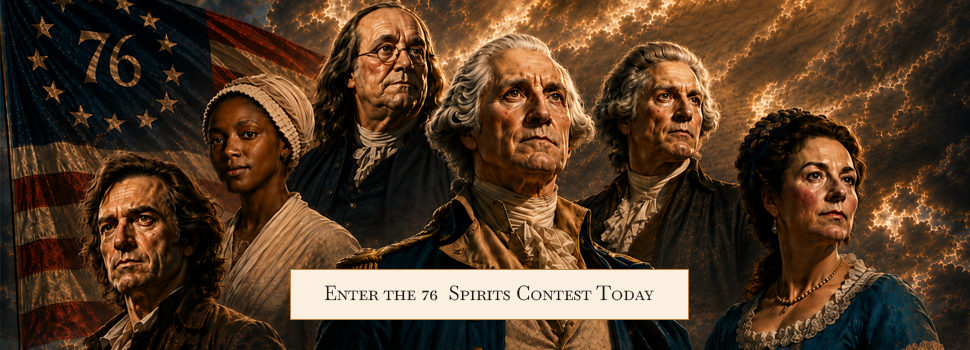
A Declaration from the 76 Spirits
They pledged their lives, their fortunes, and their sacred honor to build a nation. Now they have returned, and they are not content with what has become of the place.
Preamble
We the Spirits of Seventeen Seventy-Six, returned from death’s long silence to witness what has become of our great experiment, compelled by the urgency of this hour and the peril facing the Republic we pledged our lives to birth; in order to reconstitute the bonds of democratic union that now fracture and fail, to re-establish Justice against the rising tide of authoritarianism, to restore domestic Tranquility torn asunder by manufactured division, to provide for the common defense of Truth in an age of weaponized lies, to promote the general Welfare against those who would pillage it for private gain, and to secure anew the Blessings of Liberty to ourselves and our Posterity, a Liberty now endangered by the very tyrannies we fought and died to defeat; do hereby proclaim and establish this Re-Constitution for the United States of America.
We did not leave you a finished country. We left you an imperfect document and a more perfect union to chase, a charter written to be argued with, amended, and outgrown by people who would see farther than we could. That was never a flaw in the design. It was the design. What follows is not a replacement for the Constitution you already hold. It is a reminder of what it says, and a plain accounting of how far you have wandered from it.
Article I. The Legislature.
All legislative power was placed here first, and by design, in the branch built closest to the people and nearest the purse. We made it the First Article because we meant it to stand first among the three: the people’s own hands upon the law and upon the money.
We gave this branch a spine. We would be obliged if its present occupants would locate theirs. A Congress that waits to be told what to want, that surrenders its power over war, over the treasury, and over the plain duty of oversight to whoever holds the other end of the avenue, is no longer a branch of government. It is a seal, pressed wherever another hand directs. The people’s House was never meant to be the instrument of one man’s ambition.
So we remind you: the purse is yours. The summons is yours. The power to make a law, to fund it, and to refuse it is yours. Take up the gavel you have set down. A legislature that will not legislate has already cast its vote, in silence, for a king.
Article II. The Executive.
This office was made to execute the laws, and to execute them faithfully. Not to write them. Not to repeal them. Not to proclaim them by night, on a whim, to whoever happens to be listening. We drew it with care, for we had just finished a war against a man who confused himself with the state, and we had no wish to raise up his likeness here.
It is a desk, not a throne. A term, not a reign. A public trust, not a family inheritance. The oath is sworn to the Constitution, not to the man who happens to stand upon it this season. An executive who rules by decree, who treats the courts as suggestions and the Congress as his staff, who asks the country to be loyal to him rather than to its law, has mistaken the chair for a crown.
We have buried one king. We are not in want of another. Execute the laws faithfully, sir, or faithfully stand aside.
Article III. The Judiciary.
We promised the people Justice, and we gave her a blindfold for a reason, that she might not see the wealth, the party, or the power of whoever stood before her. We did not give her a purse to fill.
The bench answers to the Constitution. Not to the patron who funded the seat, not to the faction that filled it, not to the man who flatters it and expects a favor in return. A robe is a duty, not a costume, and a court that trades its judgment for access has surrendered the one thing that made it a court.
Independence was the whole of the point. A judiciary that bends to the strong is no longer a court but an usher, walking tyranny to its seat. Hold the line we built you to hold, or confess that you were never holding it.
Article IV. The States and the People.
Whatever power we did not expressly grant to the government, we left where it began, with the people, and with the states they keep. You are citizens, not subjects; sovereigns, not entries in another man’s ledger. Your vote is not a privilege to be rationed, your citizenship is not a favor to be revoked, and your right to move, to speak, to worship, and to assemble does not expire the moment it grows inconvenient to the powerful.
We built a balance between the nation and the states so that no single hand could close around the whole country at once. Those who would collapse that balance, who would reward the states that comply and punish the states that dissent, who would sort a free people into the loyal and the disloyal, do not strengthen the union. They dismantle it, and call the rubble order.
The power was always yours. It is lent to the government, and never the reverse. Recall it when it is abused. That is not rebellion. That is the lease
Article V. Amendment.
If it no longer serves you, change it. We built the door, and we left it unlocked.
We meant the door to be heavy, never barred: heavy enough that no faction could rewrite the house in a fit of temper, light enough that a people in true agreement could always pass through. We required broad consent on purpose, so that change, when it came, would be change the whole country could live with.
We did not foresee a people so evenly and so bitterly divided that they agree on nothing, and so can change nothing, a Constitution frozen not by its own weight but by your refusal to find one another. That lock is not in the parchment. It is in you. The amendment you most need is written in no article: it is the willingness to grant that the citizen across from you is not your enemy. Find that common ground, and the door opens still. Refuse it, and you will go on mistaking your paralysis for our design.
Article VI. The Supreme Law, the Oath, and the Conscience.
This Constitution, and the laws made in keeping with it, are the supreme law of the land, above every office and every officer: above the President, above the Congress, above the courts, and above us. No person is too powerful to be bound by it. That was the whole of the idea. We had known a king who stood above the law, and we wrote a country in which no one would stand there again.
Every oath of office is sworn to that law, and to no man. An official who pledges his loyalty to a person rather than to the Constitution has sworn the wrong oath, and ought to be spared the chance to break it.
And we said, plainly, that there shall be no religious test, and we set a wall between the altar and the state, not to banish faith but to keep it free. Worship as your conscience commands, or not at all. But let no one wrap a hunger for power in the robes of the Almighty, nor take up God as a cudgel against a neighbor. We parted the two because we had seen what they do when they are joined.
Article VII. Ratification.
The original was sent out to the people, who argued over it in their own conventions and made it theirs. We send this back to you the same way.
We cannot ratify it. We are dead, and the dead get no vote, which is the one rule of yours we wholeheartedly endorse. Ratification, in a republic, has a plainer name: it is something you do, not something you sign. You ratify the Constitution each time you read it, defend it, vote it, and refuse to surrender it. You repeal it, quietly, each time you look away.
We pledged our lives, our fortunes, and our sacred honor to begin it. That pledge now passes to you. We began it. You must finish it.
The Amendments. The Liberties and the Widening Circle.
We wrote a charter of power, and then we were reminded, rightly, that a charter of power is but half a country. So we added the other half: a list of the things the government may never do to you. The first ten amendments are not an afterthought. They are the fence around the citizen, and we built that fence because we had lived without one.
You may speak, and print, and worship, and gather, and require of your government that it answer you. You may not be searched upon a whim, jailed upon a word, tried in secret, or punished with cruelty. And lest anyone mistake the list for the whole of your liberty, we said plainly that the rights we named are not the only rights you hold, and that the powers we withheld remain withheld still. The silences in the document were meant to fall in your favor, and not the state’s.
Then the country did the thing we had been too frightened, or too compromised, to do ourselves. It widened the circle. It struck down slavery, and wrote into the supreme law that every person born here belongs here, and that no state may deny to any person the equal protection of the laws. It declared that the vote could not be denied for the color of a man’s skin, then for the fact of a woman’s sex, then for the want of a coin, then for the youth of one old enough to be sent to war. Every one of those amendments made the words We the People mean more people. That was no betrayal of our work. It was the completion of it. We wrote of a more perfect union because we knew we had not reached it.
So hear this plainly, and in the present tense. Citizenship by birth is not a privilege the powerful may revoke. The equal protection of the laws is not a sentiment; it is a command. The vote is not a reward for the agreeable. A right you decline to use is a right you are teaching the government that it may take. Guard the fence. We did not build it for ornament.
A Final Word from General Washington
I returned because you called for us. Not in séances, nor in prayers, but in your late and uneasy asking of what the founders would think. So I will answer, plainly, as I tried to answer the country once before, on the day I laid the power down. We were not gods. We were flawed and frightened men and women who looked upon tyranny and said no, and then did the harder thing, which was to build something in its place and walk away from it, so that no one would ever mistake the founders for the owners.
Stop worshipping us. Begin surpassing us. The Republic was never the building, nor the parchment, nor the names cut into stone. It was always, and only, the willingness of ordinary people to keep it.
Keep it.
We are the 76 Spirits. We have been dead for centuries, and we are not finished fighting.
Neither should you be.
The 76 Spirits, still arguing, still fighting, still believing.