
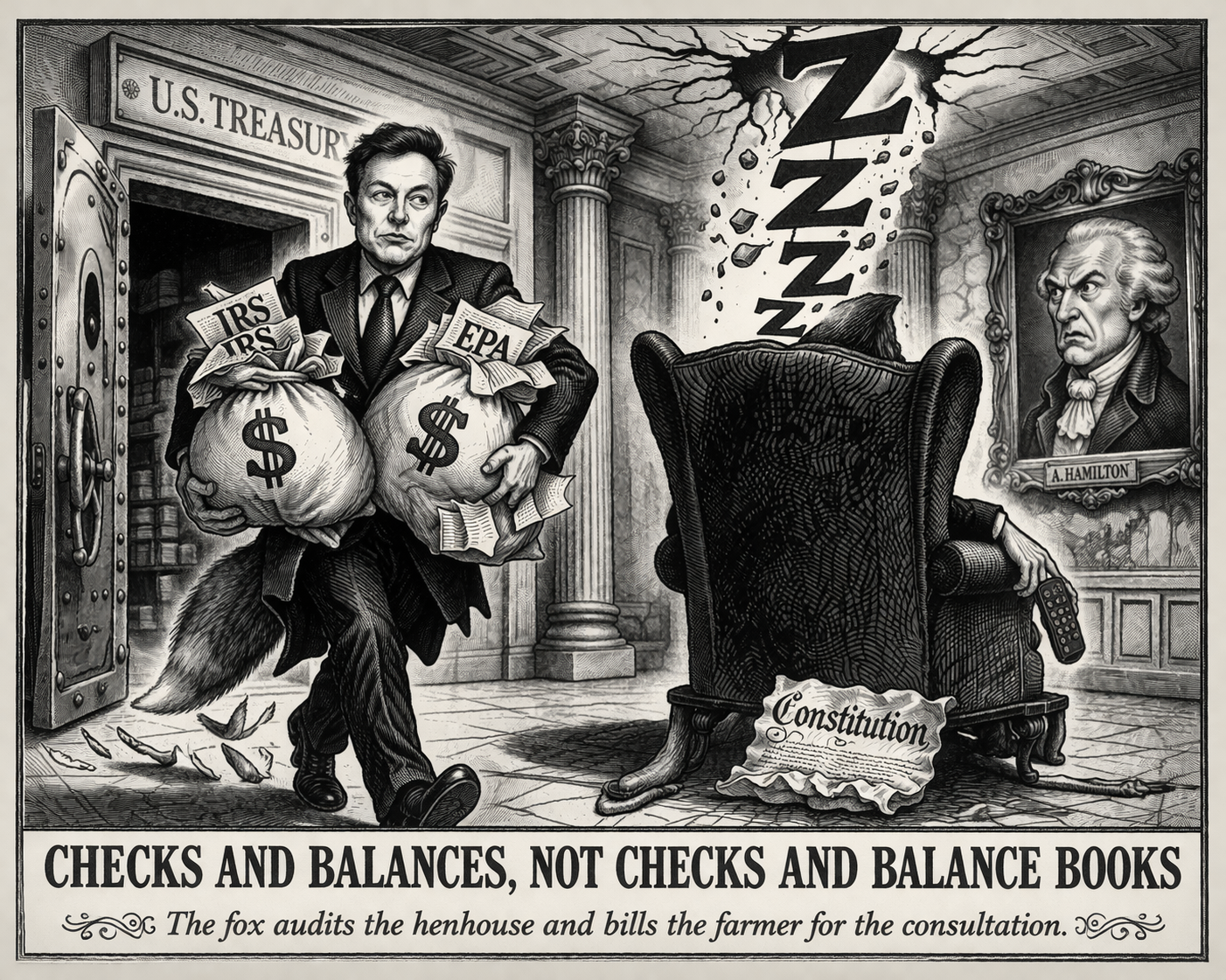
They have swept away the checks and balances and replaced them with checks to line the pockets of the looters and balance sheets to cover their tracks.
I do not mince words. I never did. A fraternity of oligarchs, men whose wealth exceeds the gross product of nations, has seized the machinery of the Republic and is dismantling it for parts. They promised to drain the swamp. Instead they dragged the city on the hill down into it. What was built upon a summit now sinks into mire, and the men holding the shovels have the audacity to call it renovation.
An unelected billionaire was handed the keys to the federal treasury and told to cut. He promised two trillion dollars in savings. He achieved, by the most generous independent accounting, perhaps one hundred and five billion, much of which was illusory, and much of which has cost the public far more than it saved. The Internal Revenue Service, which I would remind you collects the revenue upon which the entire government depends, lost more than seventeen thousand employees. The projected cost in uncollected revenue over the coming decade: five hundred billion dollars. You do not need to have founded the national banking system to recognize that firing the people who collect your taxes does not reduce your debt. It increases it. This is not efficiency. It is either incompetence or sabotage, and in either case it is unforgivable.
They cut the personnel who monitor threats to the homeland. They cut the officers who assist American citizens stranded abroad. They cut the scientists, the inspectors, the prosecutors. And they did this while launching an unauthorized war in the Middle East that will cost more in a single month than the agencies they destroyed would have cost in a decade. This is not fiscal conservatism. It is arson dressed in an accountant’s suit.
A man whose commercial empire holds twenty billion dollars in government contracts has been given authority to dismantle the agencies that regulate his own enterprises. The inspectors who monitored his factories have been dismissed. The lawyers who reviewed his contracts have been reassigned. The accountants who audited his books have been let go. This is not reform. This is the East India Company being handed the keys to Parliament.
I designed a Treasury. I did not design an oligarchy.
This distinction, which ought to be self-evident to any citizen who has read the Constitution even once, appears to have escaped the notice of those presently ransacking the federal government under the pretence of fiscal responsibility. So permit me, as the man who built the financial architecture of this Republic from whole cloth, to make the matter plain.
The system of checks and balances enshrined in our Constitution was never a bookkeeping exercise. It was, and remains, a theory of distributed power. The Congress checks the Executive. The Judiciary checks them both. The States retain their sovereignty. The People retain theirs. This was not an accounting system. It was a declaration of distrust in concentrated authority, earned through bitter experience with a King who taxed us without representation and quartered soldiers in our homes to remind us who held the ledger.
I say this not as some enemy of fiscal prudence. I wrote the plan for assumption of state debts. I established the national bank. I argued, sometimes against the very men whose Spirits now sit beside me on this improbable editorial board, that a functioning treasury was the spine of a functioning republic. I believed it then. I believe it now. Sound public finance is not the enemy of liberty; it is a condition of liberty.
But what is happening in your streets today is not a dispute about budgets. Millions now march from the Embarcadero to Civic Center Plaza, from Arlington across Memorial Bridge to the National Mall, from three converging routes to the steps of the Minnesota State Capitol, in more than three thousand cities and towns across this nation. They are not protesting fiscal responsibility. They are protesting the replacement of constitutional governance with the private ambitions of men who confuse their personal balance sheets with the public interest.
I watched a young woman named Yohanna in New York hold a sign that read simply: “Not in my name.” In Philadelphia, Linda Thomas, seventy-four years old, stood where I once stood and wept, because she remembered what this country was supposed to be. In Verona, Wisconsin, Carrie Haack looked at her neighbors and asked the only question that matters: if not us, who?
I knew that question. It was asked in every tavern from Boston to Savannah in 1774. The Committees of Correspondence did not wait for permission. They organized because the alternative was silence, and silence was consent.
When Parliament passed the Stamp Act, the colonists did not object to taxation as a concept. They objected to taxation without representation, to the principle that a distant authority could reach into their pockets without their consent. When the East India Company was granted a monopoly on tea, the issue was not the price of the beverage. It was the precedent: that a private commercial interest, operating with the blessing of the Crown, could be granted dominion over an entire market at the expense of local enterprise. The tea went into the harbor not because it was expensive but because it was a symbol of capture.
Today, the capture is not symbolic.
In Chicago, a seventy-one-year-old man named Freberg carried a sign mocking the president. His frustration is plain, and I use his words precisely: pointless wars, control by billionaires, and a criminal president. Also in Chicago, Maria Isabel Trejo, attending her third No Kings rally, asked the question that deserves an answer: if the United States has money to start a war with Iran, why does it not have money to support its own people?
I know this question. I have been hearing it for two hundred and fifty years.
When I presented my Report on Manufactures to Congress in 1791, I argued that public investment in the productive capacity of the nation was not a luxury but a necessity. A republic that could not feed, clothe, and employ its citizens would not long remain a republic. The treasury existed to fund the common welfare, not to enrich a merchant class at the expense of the laboring one. I was no radical; I believed in commerce, in banking, in the mechanisms of capital. But I understood, as my opponents sometimes did not, that an economy which served only the wealthy was an economy preparing its own revolution.
Mrs. Trejo’s question is the same question I answered in that report. The money exists. It always exists. The question is for whom it is spent, and by whose authority. When the agencies that monitor homeland threats are gutted while an unauthorized war is launched in the Middle East, that is not fiscal responsibility. That is the funding of spectacle at the expense of security.
In San Francisco, I watched an eighty-one-year-old woman named Ginny march with the same steady resolve she has carried since the war in Vietnam. Nothing compares to the state of the country today, she said. We were suffering then. But not like we are now.
I take Mrs. Ginny at her word. She has earned it. She has been standing in the streets longer than most of your senators have been alive, and she has seen enough to make the comparison with authority. When a woman of eighty-one years, who has lived through Vietnam, Watergate, the Iran hostage crisis, the financial collapse of 2008, and two impeachments, tells you that nothing compares to this, you would do well to listen.
In New Jersey, Allison Posner brought her daughters to the rally so they would understand that democracy is not a spectator sport. In Aurora, Illinois, Ruben Maciel-Perez marched to protect the future his parents came to this country to build. In a church in Chicago, a man named John Baker prayed for the soul of the country and then went to the march, because prayer alone was not enough.
These are not radicals. These are not agitators. They are the state. They are exercising the very right of peaceable assembly that we wrote into the First Amendment because we knew, from personal and painful experience, that governments which silence dissent become governments which deserve to be overthrown.
I designed a financial system in which the government would borrow against the full faith and credit of the People. Mark those words: the full faith and credit of the People. Not of any individual. Not of any private concern. Not of any man, however wealthy, however convinced of his own indispensability. The public debt, which I championed when it was deeply unfashionable, was a mechanism for binding the states together in common interest. It was a tool of union. It was never intended to be a tool of plunder.
When a man who holds contracts worth twenty billion dollars with the government he is dismantling sits in the seat of power and directs the dismissal of the regulators who oversee his own enterprises, that is not a check on government excess. That is the absence of checks entirely. That is the fox, as Mr. Franklin would say, auditing the henhouse and billing the farmer for the consultation.
Here is what the marchers understand that the men in the palace do not: a republic’s books must balance, yes, but a republic’s balances must also hold. The fiscal ledger and the constitutional ledger are not the same document. You may reduce expenditures to zero and still have a tyranny. You may run a deficit and still have a free people. The question is not whether the numbers add up. The question is whether the power is distributed, whether the institutions function, whether the courts can compel, whether the Congress can legislate, whether the citizen can speak and assemble and petition without fear of reprisal.
In Jekyll Island, Georgia, where the architects of the Federal Reserve met in secret in 1910 to design the central bank that would succeed mine, Monica Carter stood in the rain, holding a sign that asked who the economy serves. She is asking the right question in the right place.
I knew men like the ones now occupying your federal agencies. One was a recent college graduate who had worked in private equity. Another had attended university for a single year. They were sent into the departments by a billionaire’s lieutenant, and they behaved as occupiers in conquered territory. In my time they were called Loyalist placemen: men appointed not for competence but for compliance, installed in colonial offices to extract revenue and suppress dissent on behalf of a distant authority. We fought a war to remove them.
In Superior, Wisconsin, Cindy Stark, sixty-eight years old, spoke plainly: people keep showing up because they have realized how important it is to speak their minds and to speak out against the current government. Near her, a woman named Anne Moors spoke of the natural rights of people to work hard and raise their families without having to look over their backs.
Natural rights. Mrs. Moors used the phrase as though it were obvious, as though she had always known it. She may not know that this phrase was the philosophical foundation upon which we built the entire American experiment. Locke wrote it. Jefferson enshrined it. Madison structured a government around it. And I, whatever my reputation as the financier of the group, believed in it as fiercely as any of them. The Treasury was built to protect those rights, not to become the instrument by which they are stripped away.
I have heard the counter-argument. I have heard it for two hundred and fifty years. That the protesters are partisans. That the movement is theatre. That the streets are full of malcontents who cannot accept an election. The White House itself dismissed today’s marches as “Trump Derangement Therapy Sessions.”
King George used similar language. When colonial petitions reached London, they were described as the ravings of ungrateful subjects, men who did not understand the benefits of the system that governed them, troublemakers stirred up by a few radicals who did not represent the true sentiment of the populace. The King told Parliament that the colonists were in a state of rebellion and that decisive measures were needed to restore order. He was not wrong that we were in rebellion. He was catastrophically wrong about why.
The colonists were not deranged. They were paying attention. And they were told, as you are being told today, that their grievances were imaginary, that the economy was fine, that the authorities had matters well in hand, that protest was unseemly and ungrateful and pointless.
Rose DiGregorio, from Upper Chichester in Delaware County, who has attended all three No Kings protests, said what needs saying: we cannot do three more years of this. It is unbearable.
In St. Paul, Minnesota, Senator Sanders addressed the assembled thousands: we will not allow this country to descend into authoritarianism or oligarchy. Nearby, a melting ice sculpture of a crown dissolved in the afternoon sun while Springsteen sang about the streets of Minneapolis, honoring the dead.
The King’s crown is melting. The people are singing. The Republic is not dead, but it is gravely ill, and the illness is not fiscal. It is constitutional. It is the replacement of public governance with private ambition, the substitution of balance books for balances of power, the treatment of citizens as line items to be cut rather than sovereigns to be served.
They promised to drain the swamp. They dragged the city on the hill into it. They swept away the checks and balances and replaced them with checks to their donors and balance sheets to hide the wreckage. But the marchers in three thousand cities see through the ledger. They carry signs that say “No Kings” because they remember, even if their government has forgotten, that this nation was founded on the rejection of exactly what is being imposed upon them.
The books must balance, yes. But the balances must also hold.
Listen to the marchers. They are telling you what I told you in 1787: the power belongs to the People, and any man who forgets this will be reminded, peacefully if possible, by other means if necessary.
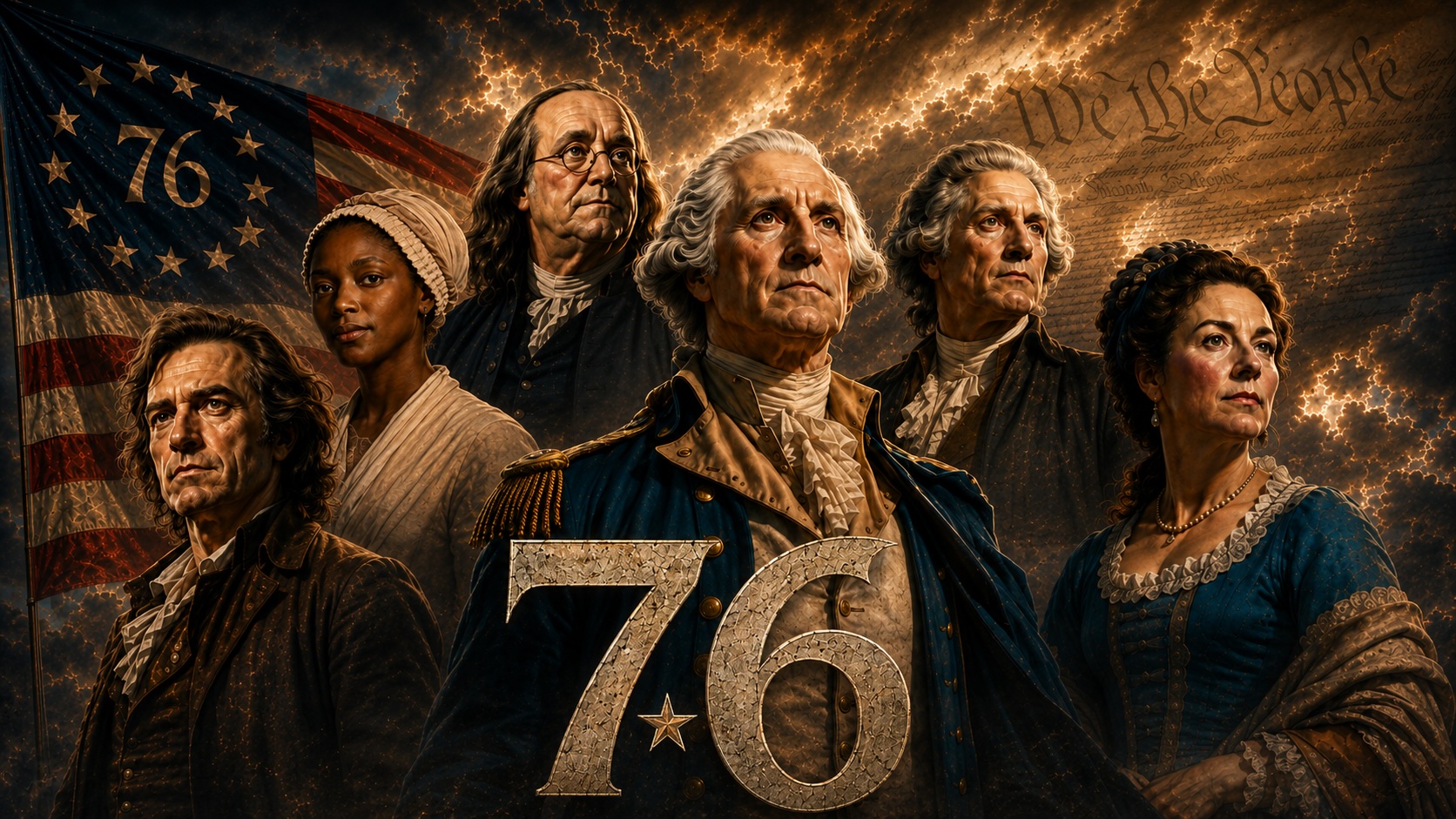
I’m Alexander Hamilton, one of 76 Spirits, reconstituted and ready to fight to preserve the Republic.


Leave a Reply
You must be logged in to post a comment.