
On the Deliberate Destruction of the Capacity to Govern
I designed a machine to prevent the very thing that is now happening.
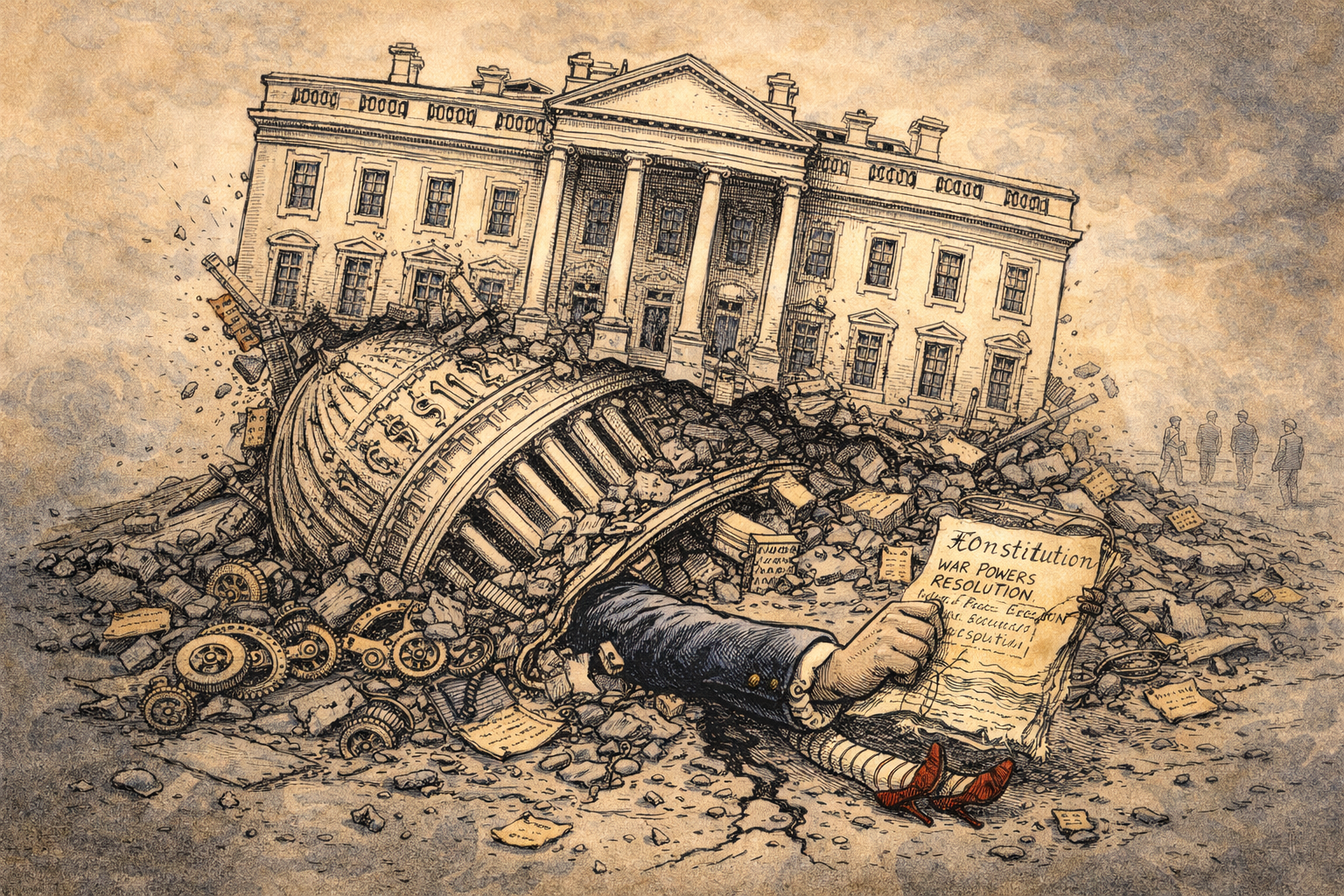
Let me say it plainly, for I have watched this Republic for two and a half centuries and I know the signs. What is taking place in the United States of America is authoritarianism. Not the impending threat of it. Not the distant possibility of it. The thing itself. It is here. It has been here for some time. And it arrived not by the method we most feared, not by a general crossing the Rubicon with his legions at his back, but by a method I confess I did not sufficiently guard against: the elected legislature, entrusted with the defense of the Republic, is taking an ax to the supports that hold it up.
When we deliberated at Philadelphia in the summer of 1787, we spent more time on the structure of the legislature than on any other question. This was not because we trusted the Congress above the other branches. It was because we understood that the Congress was the keystone. Article One comes first for a reason. The legislature holds the power of the purse. The legislature declares war. The legislature confirms appointments, conducts oversight, impeaches officers of the government, and writes the laws under which the executive must operate. Remove Article One from the constitutional architecture and what remains is not a republic. It is an elected monarchy, restrained by nothing but the character of the monarch; and we had fought a war to establish that the character of the monarch is never a sufficient restraint.
In our time, we had a word for legislators who surrendered their powers to a crown. We called them combatants, or we called them cowards. In either case we understood that when the people’s representatives voluntarily abandon their constitutional duties, they do not merely fail in their office. They become instruments of the very tyranny the office was created to prevent.
This is what I am witnessing. Not an executive who has seized power from a resisting Congress, but a Congress that is handing it over, plank by plank, and calling the demolition progress.
Permit me to describe the instrument of this demolition, for its character reveals its purpose.
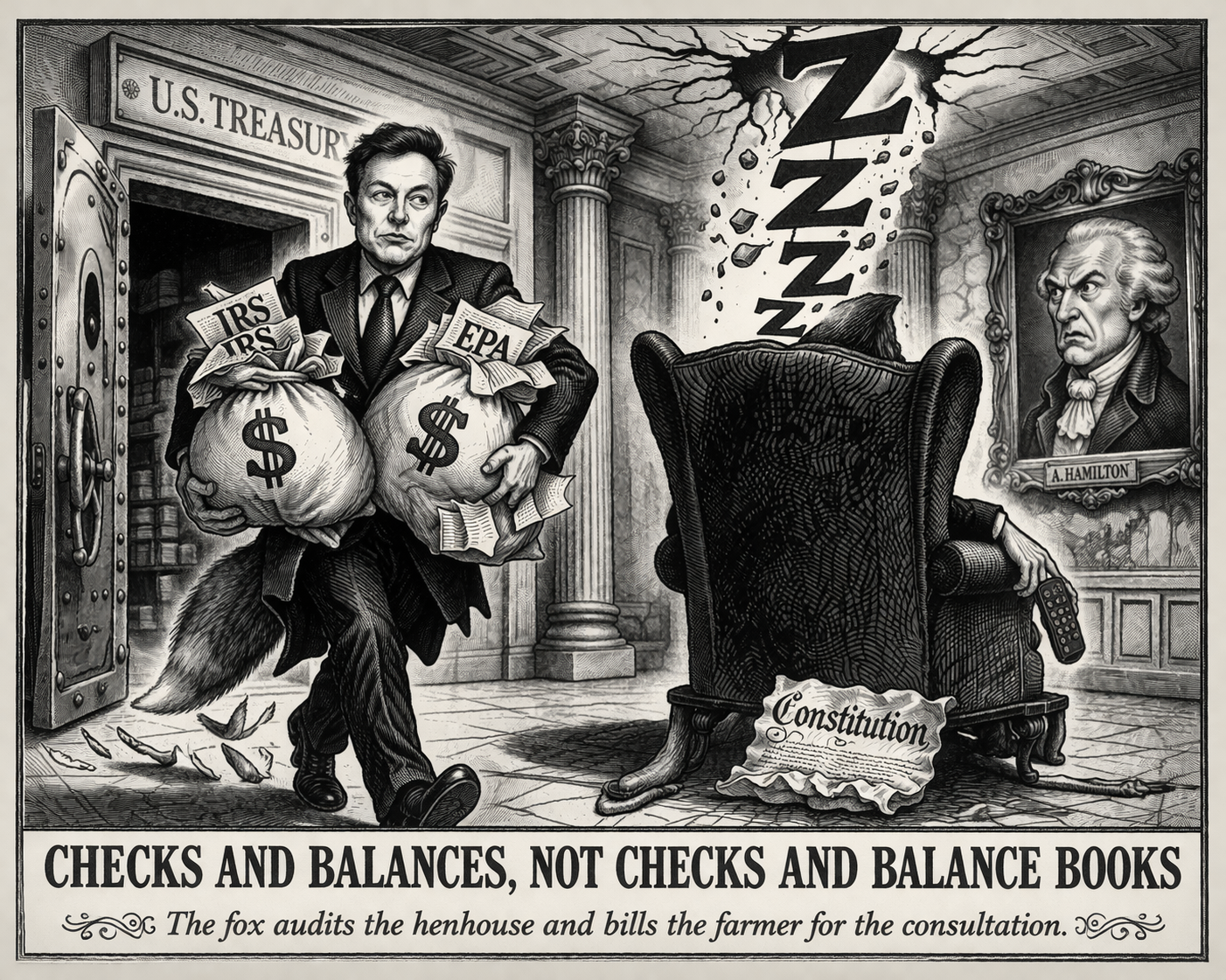
In January of 2025, the executive established by order an entity called the Department of Government Efficiency. It was not a department in any constitutional sense. Congress did not create it, did not fund it, did not define its authorities, and did not provide for its oversight. It was conjured into existence by executive fiat, placed under the direction of a man of immense private fortune whose commercial enterprises are themselves subject to federal regulation, and staffed with his associates; young men, largely, who possessed great confidence in their own abilities and no experience whatsoever in the operation of a government.
I am reminded of nothing so much as the royal commissioners whom George III dispatched to the colonies in the years before the Revolution. They too arrived with instructions from a distant authority. They too regarded the existing institutions as impediments to the will of the Crown. They too possessed the certainty that accompanies ignorance of local conditions. And they too were astonished when the machinery they dismantled turned out to have been performing functions they had not troubled themselves to understand.
The commissioners of this new dispensation were given access to the internal mechanisms of agencies whose purposes they could not name. They terminated contracts they had not read. They cancelled grants whose beneficiaries they could not identify. They discharged employees whose functions they did not comprehend. In one documented instance, they obtained the private identifying information of more than three hundred million American citizens and placed it upon an unsecured computing apparatus, in violation of a judicial order. At the Social Security Administration, an operative of this entity signed official documents under a false designation, representing himself as an employee of the agency he was dismantling.
And where was Congress? Where were the people’s representatives, the men and women sworn to defend the constitutional order, the stewards of Article One?
They took up the ax and swung harder.
I must pause here, for I find that anger, however justified, is a poor substitute for perspective, and perspective is what two and a half centuries of observation affords.
When I left this world in 1836, the Republic was young and its promises were largely promissory. Liberty was proclaimed but not extended. Happiness was pursued but not widely shared. The machinery of self-governance that we built at Philadelphia was, I freely acknowledge, an imperfect engine, designed by imperfect men, several of whom, myself included, held other human beings in bondage while writing constitutions that declared all men to be created equal. The contradiction was not invisible to us. It was intolerable, and we tolerated it, and that failure is mine to carry.
But what I have witnessed since, the arc of these two hundred and fifty years, has been, in its totality, the most extraordinary vindication of the principles we professed but failed to honor. And the instruments of that vindication have been, in large measure, the very things now under assault: science, social progress, and the hard, slow, costly extension of rights to those from whom they were withheld.
Consider what the citizens of this Republic have accomplished. They harnessed the force of lightning and made it illuminate their cities. They conquered diseases that had plagued humanity since antiquity; smallpox, which ravaged our armies and terrified our children, has been eradicated from the face of the earth by the collaborative effort of scientists, public servants, and the institutions of government that organized and funded their work. They built machines that fly. They sent men to the moon and brought them home. They constructed a network of instantaneous communication that connects every citizen to every other, a thing so far beyond what Franklin imagined with his electrical experiments that I sometimes wonder if he would weep or laugh.
And more remarkable still, more consequential than any mechanical invention, they undertook the painstaking, bloody, unfinished work of making the Republic’s promises real. They fought a war to end the enslavement that we, the founders, had been too cowardly or too compromised to abolish. They extended the franchise to women, whom Abigail had implored us to remember and whom we, to our lasting disgrace, did not. They dismantled the legal architecture of racial subjugation. They established protections for the laborer, the child, the elderly, the disabled. They built systems of public education, public health, public safety, and public accountability that transformed the phrase life, liberty, and the pursuit of happiness from an aspiration into something approaching a lived reality for millions who had been excluded from its promise.
Every one of these achievements required the capacity of government to act. Every one required trained public servants, funded institutions, enforced regulations, and a legislature willing to translate the will of the people into law. Every one required, in short, the machine.
And every one of them is now imperiled. Not by foreign invasion. Not by natural calamity. Not by any force beyond human control. They are imperiled by the ambitions of a small number of men of immense private wealth who have determined that the Republic’s capacity to regulate their conduct, to tax their fortunes, to hold them accountable to the same laws that govern the farmer and the shopkeeper, is an inconvenience they will no longer suffer. They have purchased influence. They have funded factions. They have installed sympathetic officers in positions of authority. And when the machinery of government persisted in performing its function, which is to say, persisted in treating them as citizens rather than sovereigns, they resolved to destroy the machinery itself.
In the political philosophy of our era, we had a word for government by the wealthy in their own interest. We called it oligarchy, and we considered it a disease of republics, not a form of governance. Aristotle classified it among the corruptions. We agreed. The Constitution was designed, among its other purposes, to prevent the concentration of both political and economic power in the same hands, for we understood that when wealth purchases government, the citizen ceases to be sovereign and becomes subject.
Two hundred and fifty years of progress, of science, of social invention, of rights extended and promises honored, and the ax falls not upon tyranny but upon the very institutions that made the progress possible. The irony is bitter enough to choke upon.
Let me now be precise about the damage, for I have learned over the centuries that precision is the enemy of those who prefer to govern by impression.
In twelve months, three hundred thousand federal employees departed their posts. This is the swiftest reduction of the civil establishment since the armies were sent home after the great war of 1945, but that comparison misleads. The demobilization of 1945 was the orderly conclusion of a temporary expansion undertaken for a defined purpose. What has occurred since January 2025 is of an entirely different character. It is the deliberate crippling of the Republic’s permanent capacity to function.
The men and women who departed were not combatants returning to civilian life. They were the clerks who process the pensions of the elderly. The inspectors who examine the safety of the food upon your table. The examiners who ensure that the wealthy pay the taxes they owe. The nurses who tend the wounds of veterans. The researchers who track the spread of disease. The lawyers who enforce the protections of civil rights. The scientists who monitor the contamination of your water and the condition of your soil. The custodians, in the most literal sense, of the machinery that translates the promises of law into the reality of governance.
Four million years of accumulated knowledge and experience departed with them. I shall write that figure again, for it warrants contemplation. Four million years. The understanding of how the gears connect, which levers operate which mechanisms, where the stress points lie, what has been attempted before and why it failed; all of this, gone. Not because it had become unnecessary, but because it had become inconvenient to men who wished to exercise power without the encumbrance of a government competent enough to restrain them.
Consider the consequences as they have already manifested. The Social Security Administration, which serves more of your citizens than any other civilian agency, now operates at a staffing level not seen in half a century, even as the population it serves has doubled. Half of those who telephone for assistance abandon the effort before a human voice answers. The computing systems have failed under the weight of citizens driven from closed offices to an apparatus unequal to the demand. The elderly, the disabled, the veterans; those least equipped to endure bureaucratic privation; are the ones most grievously harmed.
The revenue service has lost one quarter of its personnel. Its own assessors project a loss to the Treasury exceeding five hundred billion dollars as a consequence. Ponder the arithmetic. An enterprise undertaken in the name of economy has cost the Republic more than it could plausibly have saved if every one of its claimed efficiencies had been genuine, which they were not. Independent examination has found the initiative’s accounting to be replete with errors, overstatements, and fabrications. Its thirteen largest claimed savings were all false.
The Department of Veterans Affairs planned to discharge eighty thousand of its people; one in five of those who serve the men and women this nation sent to fight its wars. Nine thousand nurses departed in a single year. The department responsible for the education of the nation’s children has been gutted. The bureau established to protect citizens from predatory financial practices has been hollowed from within by a man appointed to oversee it who had publicly called for its destruction. The agency that monitors the outbreak of disease lost one tenth of its capacity. The aid programs whose termination has, by careful independent estimate, contributed to nearly eight hundred thousand deaths abroad, most of them children; these were cancelled not by an act of Congress but by the stroke of an executive pen.
And the people who managed the nation’s store of nuclear weapons were dismissed, then hastily recalled when someone in the administration bethought himself of the consequences. I confess this particular detail arrests me. They fired the custodians of the most destructive force ever assembled by human hands, and then remembered, after the fact, that someone ought to be minding it.
I anticipate the objection, for it is the same objection that has been offered in defense of every concentration of power since the Caesars. The government was bloated. It was wasteful. It had grown beyond its proper scope. It required correction.
I do not dismiss this entirely. I have observed the federal establishment for two centuries and a half, and I can attest that not every expansion was prudent, not every expenditure was warranted, and not every office justified its continuation. The desire to reform, to eliminate genuine waste, to ensure that the apparatus of governance serves the citizen rather than itself; this is a legitimate aspiration. It is an aspiration I share.
But reform is not what occurred. Reform requires deliberation. It requires the identification of specific inefficiencies, the careful analysis of consequences, the preservation of essential functions, and above all, the participation of the legislature whose constitutional authority encompasses the organization and funding of the government. What occurred was none of these things. What occurred was destruction undertaken with the haste of men who feared that deliberation would expose their true objectives.
The true objectives are now visible to anyone willing to see. Sixty-four percent of federal expenditure consists of Social Security, Medicare, health programs, income security, and veterans’ services. Another fourteen percent is interest upon the national debt. Thirteen percent is national defense. Everything else, every agency gutted, every office closed, every inspector fired, every scientist dismissed, occupies a sliver of the budget so narrow that its complete elimination would not meaningfully alter the fiscal position of the United States. The men who conducted this campaign knew this. They had access to the figures. They proceeded anyway.
Because the purpose was never economy. The purpose was incapacitation. Every function that was destroyed, every office that was shuttered, every experienced public servant who was driven out, represented the Republic’s capacity to enforce its own laws. The tax examiner who ensures the wealthy pay their obligations. The regulator who prevents the corporation from poisoning its customers. The inspector who holds the powerful to account. These are the checks upon private power that a functioning government provides. Remove them and you do not produce efficiency. You produce impunity.
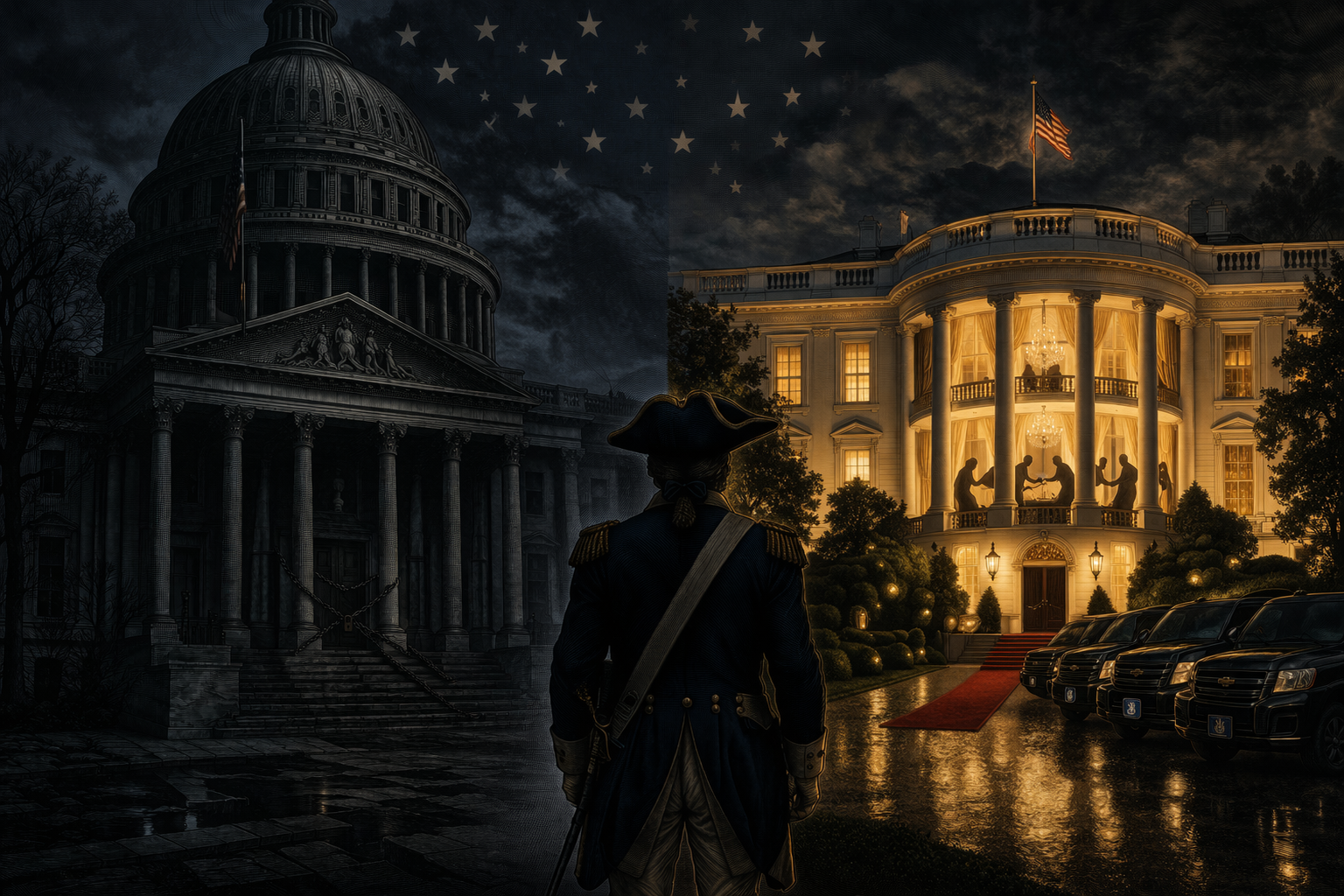
But the oligarchs, however wealthy, however ambitious, could not have accomplished this alone. I return to where I began, for it is the point upon which everything turns. The essential ingredient, the one that transforms corruption into catastrophe, is the complicity of the Congress.
Article One, Section Nine provides that no money shall be drawn from the Treasury but in consequence of appropriations made by law. This is not a suggestion. It is not a norm to be observed when convenient. It is the most fundamental check the Constitution places upon executive power: the people’s representatives control the purse. An executive who spends money Congress has not appropriated, or who refuses to spend money Congress has directed him to spend, is not exercising discretion. He is exercising the prerogative of a king.
The Impoundment Control Act of 1974, enacted after a previous president attempted to withhold funds Congress had authorized, established a detailed process for the resolution of such disputes. The current administration has disregarded this law as though it were the private opinion of a minor clerk. Funds appropriated by Congress have been frozen, redirected, or cancelled by executive action. Entire agencies funded by law have been dismantled by order. And Congress, the body whose authority was violated, the body that wrote the Impoundment Control Act to prevent precisely this, has responded not with the righteous fury the occasion demands but with the meek compliance of a legislature that has forgotten it possesses the power it is surrendering.
I watched the Parliament of Great Britain in the years before our Revolution. I watched its members cede authority to the Crown by degrees, not because they were compelled but because compliance was easier than confrontation, because the spoils of proximity to power were sweeter than the thankless labor of holding that power to account. I watched the slow, voluntary diminishment of a legislature that chose comfort over duty, and I said to my colleagues at Philadelphia: we must build a system that makes this impossible.
We failed. Not because the system was poorly designed, but because no mechanism of government can withstand the willingness of those who operate it to let it fall to ruin. The checks will not check themselves. The balances will not balance themselves. A constitution is a machine made of words, and words are enforced by people, and when the people entrusted with enforcement decide that enforcement is not worth the political cost, the words become decorative.
There is one further matter I must address, for the timing demands it.
As I compose these words, the United States is at war. The military forces whose readiness depends upon experienced planners and logisticians, many of whom have been driven from their posts, are engaged in combat operations across the Middle East. The intelligence services whose institutional memory was disrupted by dismissals and departures are being asked to assess threats in a theater of staggering complexity. The diplomatic corps, reduced to a shadow, is being called upon to manage a regional conflagration that now encompasses half a dozen nations.
An army, as any officer of our Revolution could have told you, does not fight on courage alone. It fights on supply lines, on competent administration, on the accumulated knowledge of men who understand how to sustain a campaign over weeks and months. We learned this at Valley Forge, where the failure was not of bravery but of organization, where men froze and starved not because they lacked the will to fight but because the Continental Congress had not provided the apparatus to sustain them.
The apparatus is what was destroyed. And now the nation goes to war.
I will close with the truth I know best, the one I learned at Philadelphia and have had confirmed in every decade since.
A republic is not a gift. It is a machine, intricate and demanding, that requires constant maintenance by people who understand its parts and care whether it runs. The Constitution is its blueprint. The institutions of government are its gears and levers. The civil servants who operate it are its hands. And the legislature; the people’s own house, Article One, the first and most essential branch; is the engine that drives the whole.
When the engine is surrendered, the machine stops. It does not matter how well the blueprint was drawn. It does not matter how finely the gears were cast. If the men and women charged with operating the engine choose instead to hand the key to a single executive and retire to the comfort of their factional entertainments, the machine will stop, and what replaces it will not be a republic.
It has not stopped yet. The courts are still ruling. The laws are still written. The people are still sovereign, if they choose to exercise that sovereignty with the seriousness the moment demands. But the supports of Article One are splintered and the load they bear grows heavier by the day, and the men and women who should be reinforcing them are, many of them, swinging the ax.
I built this machine. I cannot operate it for you. I could never have operated it for you. That was the point.
The Republic, if you can keep it.
I am James Madison, one of 76 Spirits, reconstituted and ready to fight to preserve the Republic.



Leave a Reply
You must be logged in to post a comment.