
Responding to Ms. Magazine, “What This Moment Requires of Us: Women, Voting Rights and the Battle for Representation,”
I have been invoked.
Ms. Magazine reports that the organization RepresentWomen has adopted, as its resolution for the year of our nation’s 250th anniversary, a call to “honor Abigail Adams’ call to ‘remember the ladies’ by designing a democracy that finally harnesses women’s full participation and power.”
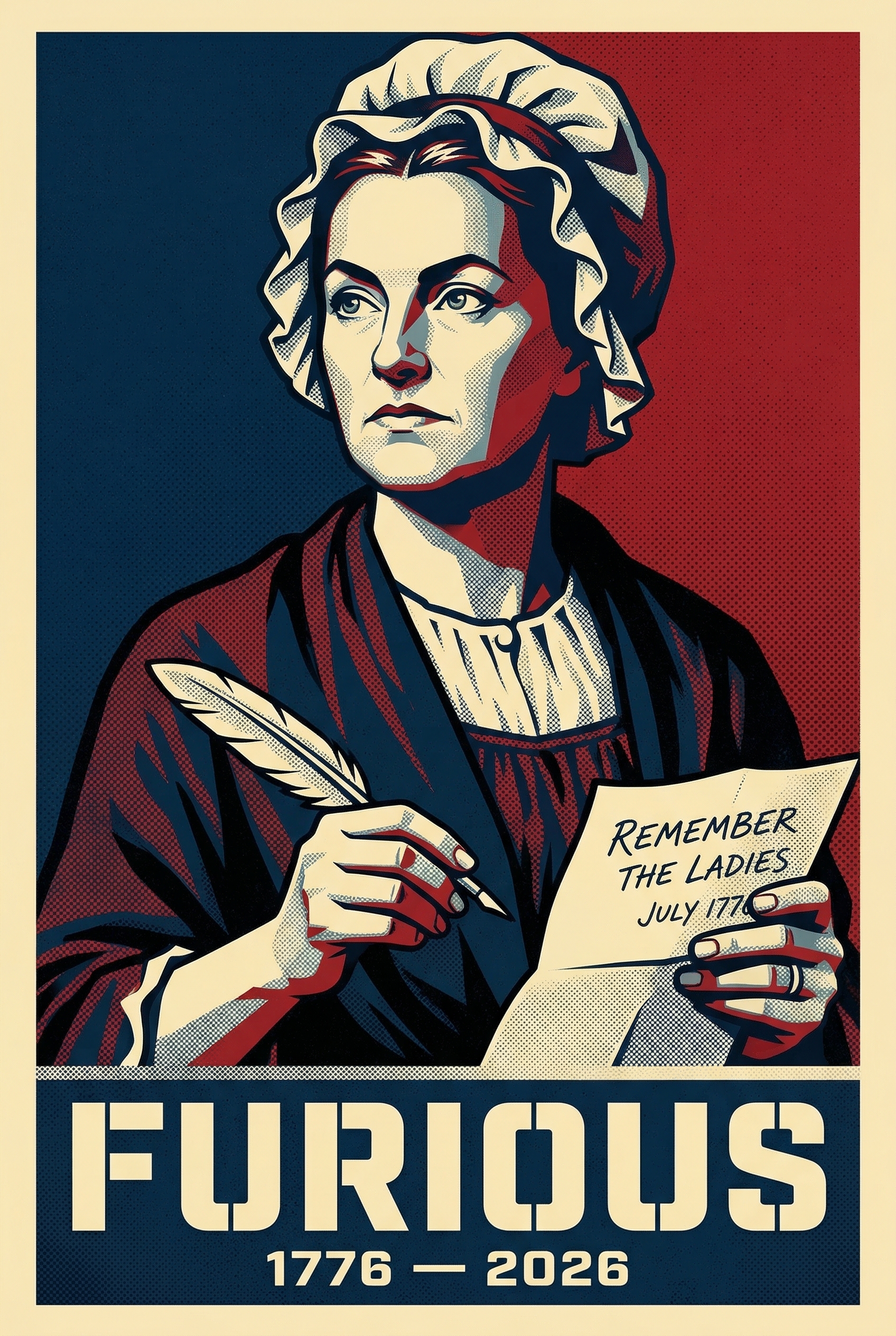
I am grateful. I am also, if the present company will forgive me, furious.
I wrote those words to my husband on March 31, 1776, three months before the Declaration was signed. I did not write them as a pleasantry. I did not write them as a sentiment suitable for embroidery, or for printing upon ceramic mugs, or for invoking at annual summits, however well intended. I wrote them as a political demand. “Remember the ladies,” I told John, “and be more generous and favorable to them than your ancestors. Do not put such unlimited power into the hands of the husbands. Remember, all men would be tyrants if they could.”
He laughed. He wrote back that my letter was “saucy,” and that he could not but laugh at my “extraordinary code of laws.” The men of the Continental Congress were too busy founding a republic to concern themselves with the question of whether half its population would be permitted to participate in it.
I have had two hundred and fifty years to consider that laugh.
I find that I am no longer amused by it. I find, in the early months of the year 2026, that the laughter of powerful men at the expense of women and girls has taken on a character so grotesque that even my long acquaintance with masculine arrogance has not prepared me for it.
Let me speak plainly, as I was known to do in my correspondence when the occasion demanded it.
The files of a man named Jeffrey Epstein have been released by the Department of Justice. They describe, in the clinical language of federal investigators, a vast enterprise of predation: the grooming, the trafficking, the rape of girls. Girls of thirteen. Girls of fifteen. Girls introduced to men of extraordinary wealth and political power, men who moved through the highest circles of American and international life with the serene confidence of those who believe themselves untouchable. The files implicate men whose names are known to every reader of this publication, whose faces have appeared beside the face of the current President of the United States in photographs that no quantity of denial can un-take, and whose capacity for cruelty toward the young and the vulnerable appears to have operated without limit or consequence for decades.
And then the bombs fell.
On February the twenty-eighth, while the nation was still reading those files, while mothers and fathers were still absorbing the scope of what had been done to other people’s daughters, the President authorized strikes on Iran. And on that same day, the first day of this war, a missile struck the Shajareh Tayyebeh girls’ elementary school in the town of Minab.
I am told the building was painted with pink flowers and green leaves.
I am told it housed girls between the ages of seven and twelve.
I am told that the teachers, upon hearing of the strikes, had begun the work of sending the children home; that they had telephoned the parents; that many mothers and fathers were still on the road, still hurrying, still believing they had time. I am told the roof collapsed before they arrived. I am told that a second strike fell upon those who had survived the first and come to help. I am told that investigations by the New York Times, the BBC, Amnesty International, and Human Rights Watch have concluded that the missile was, in all likelihood, American.
I need not be told what those mothers felt. I know.
I raised my children during the Revolution. John was in Philadelphia, and then in Europe, for years at a stretch. I was alone in Braintree with four small children, managing a farm, and the war was not an abstraction to me. I could hear the cannon fire from the Battle of Bunker Hill. I watched the smoke rise from Charlestown. I wrote to John that the sound was “tremendous.” What I did not write, because some terrors are too immediate for paper, was what I felt in my body each time the ground shook: the animal knowledge that my children were within range of things that could kill them, and that I could not make the killing stop.
If a stray cannonball had found my home; if the roof had come down upon Nabby and John Quincy and Charles and Thomas while I stood in the road, unable to reach them; I would not have recovered. No mother recovers from that. You continue to live, because the living require you, but some part of what you were is buried in the rubble with your children, and it does not come back. The women of Minab know this now. They knew it within minutes of the strike. They will know it every morning for the rest of their lives.
A majority of the American people believe that the war in which those girls were killed was launched, at least in part, to bury the files that documented what other powerful men had done to other girls. I am not in the business of conspiracy. I am in the business of observation. And I observe that the files describing the abuse of girls dominated the nation’s attention until the moment the bombs began to fall, and that they have not dominated it since. I observe that the man who authorized those bombs is named in those files. And I observe that girls are, once again, the currency in which powerful men transact their business; their bodies the cost of concealment, their lives the acceptable price of a change in subject.
“Do not put such unlimited power into the hands of the husbands,” I wrote. “Remember, all men would be tyrants if they could.”
He laughed.
Nobody is laughing now.
Ms. Magazine, in the article to which I am responding, frames the year 2026 around three questions: Where We Have Been, Where We Are, and Where We Are Going. The organization RepresentWomen has built its Democracy Solutions Summit upon this architecture, and it is a sound one. I should like to walk through it myself, though I confess my testimony may prove less diplomatic than what the summit’s organizers have in mind.
Where We Have Been.
We have been here before. Not precisely here, for history does not repeat with the fidelity of a printed page; but near enough that I recognize the landscape.
When I urged John to remember the ladies, I was not speaking only of the vote. I was speaking of power, and of the tendency of those who hold it to consolidate it beyond the reach of those they govern. “If particular care and attention is not paid to the ladies,” I wrote, “we are determined to foment a rebellion, and will not hold ourselves bound by any laws in which we have no voice or representation.” The gentlemen took this for wit. It was a prediction.
The rebellion I fomented was quiet. It was conducted through letters, through the management of a farm and a family while my husband served the Republic abroad, through the instruction of my sons in the principles I hoped they would carry into public life, and through the cultivation of relationships with those few who would listen. It was not sufficient. The Constitution that emerged from Philadelphia contained no mention of women’s suffrage. The Republic was designed, with great deliberation and considerable genius, to function without the consent of more than half its people.
It took one hundred and forty-four years from my letter to the ratification of the Nineteenth Amendment. The women who finally secured the vote in 1920 had to contend not only with the resistance of men who feared the loss of their monopoly on political power, but with the fractures within their own movement: fractures of race, of class, of strategy, of temperament. Susan B. Anthony was prosecuted for the act of casting a ballot. Sojourner Truth had to argue for her own humanity before audiences that questioned whether she possessed it. Ida B. Wells was told to march at the back of the 1913 suffrage parade and refused. Alice Paul organized silent vigils outside the White House of a president who championed democracy abroad while denying it to the women standing at his gate.
And even after the Amendment, the work was not done; it was merely begun. Many states continued to bar women of color from the polls by every means available to law and custom. It was not until the Voting Rights Act of 1965 that participation increased meaningfully among Black women and other women of color. Every expansion of the franchise has been followed by an attempt to contract it. After Reconstruction, the Redeemers. After the Nineteenth Amendment, the poll taxes and the literacy tests applied with surgical precision to those whose votes were least desired. After the Voting Rights Act, the Supreme Court’s gutting of its protections in 2013, which opened the door to a new generation of laws designed to achieve by paperwork what previous generations had achieved by violence.
This is not a failure of the American experiment. It is the experiment itself. The question has always been whether the circle of self-governance would widen or narrow, and the answer has always depended on whether the people excluded from that circle were willing to fight harder than the people attempting to keep them out.
Where We Are.
The researchers at the V-Dem Institute at the University of Gothenburg have just published their 2026 Democracy Report. I confess I find it remarkable that a Swedish university now performs the work of diagnosing the health of the American Republic; we have apparently become a patient in need of foreign physicians. Their finding is this: the level of democracy in the United States has fallen to where it stood in 1965.
I ask the reader to sit with that date. 1965. The year the Voting Rights Act was passed. The year that most scholars identify as the moment when the United States finally became, in practice and not merely in rhetoric, a full democracy.
Sixty years of work. The marches, the beatings, the fire hoses and the dogs, the murdered organizers, the slow and painful construction of a more inclusive republic; all of it returned to its starting point in the span of twelve months. The Swedish researchers report that this dissolution of democratic norms is proceeding faster in the United States than it did in Russia under Putin, in Turkey under Erdogan, in Hungary under Orban. Those men required years. This has been accomplished in a single term’s first year.
I managed a household and a farm. I balanced ledgers. I do not need a ten-point index to recognize insolvency when I see it. But the numbers confirm what the body already knows: the Republic is in debt to its own principles, and the creditors are assembling.
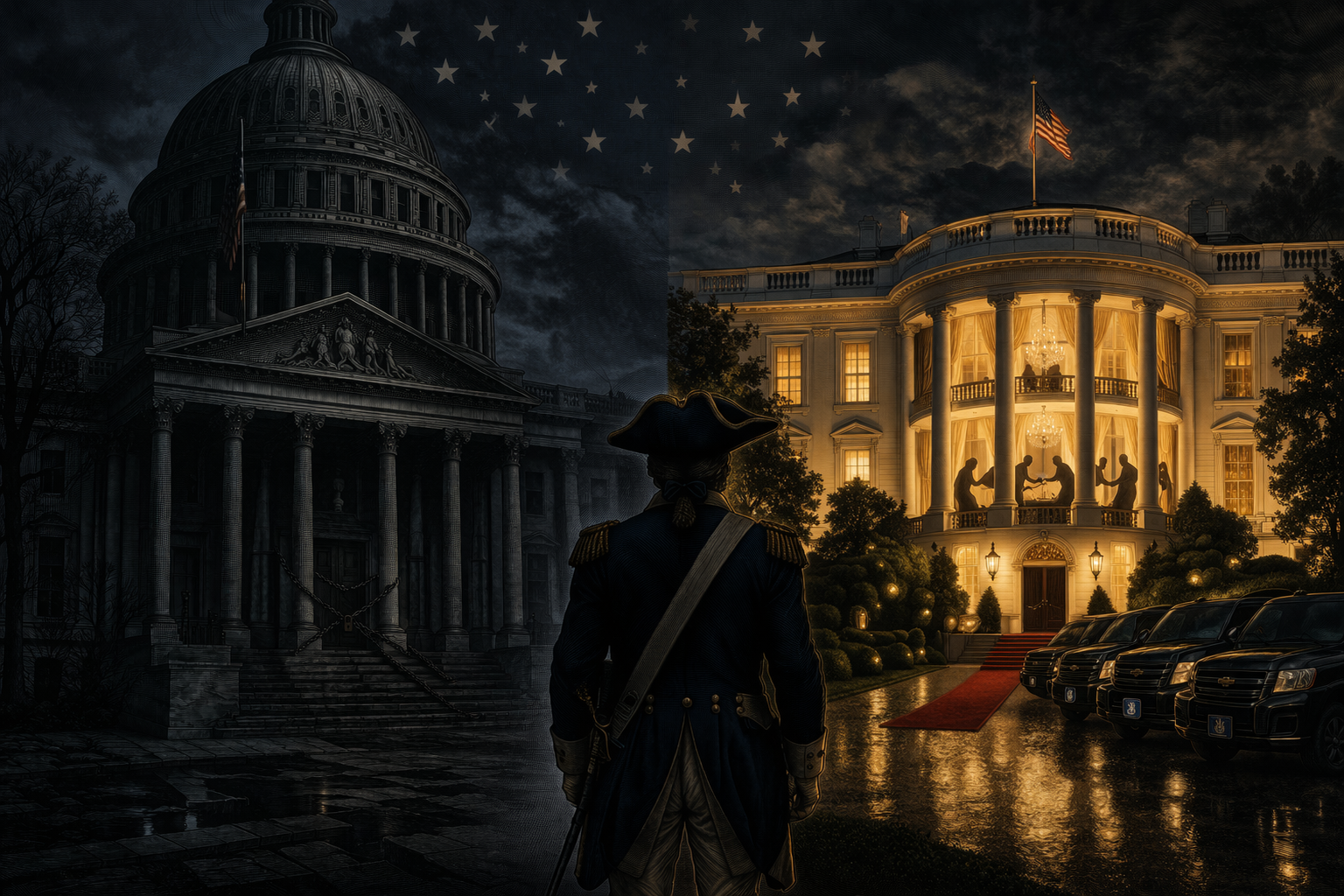
Ms. Magazine reports that RepresentWomen is calling for expanded ranked-choice voting, legislative rule changes, and the translation of women’s leadership into lasting representation. These are worthy objectives. I commend them. But I observe that reforms to the machinery of democracy presume that the machinery will be permitted to function, and I am no longer confident in that presumption. The current administration has issued executive orders attempting to override state election law. The so-called SAVE America Act has been described by legal analysts as perhaps the greatest threat to voting rights the country has ever faced. The House of Representatives has moved to ban ranked-choice voting for federal elections entirely, which would overturn adoptions in states that have already implemented it.
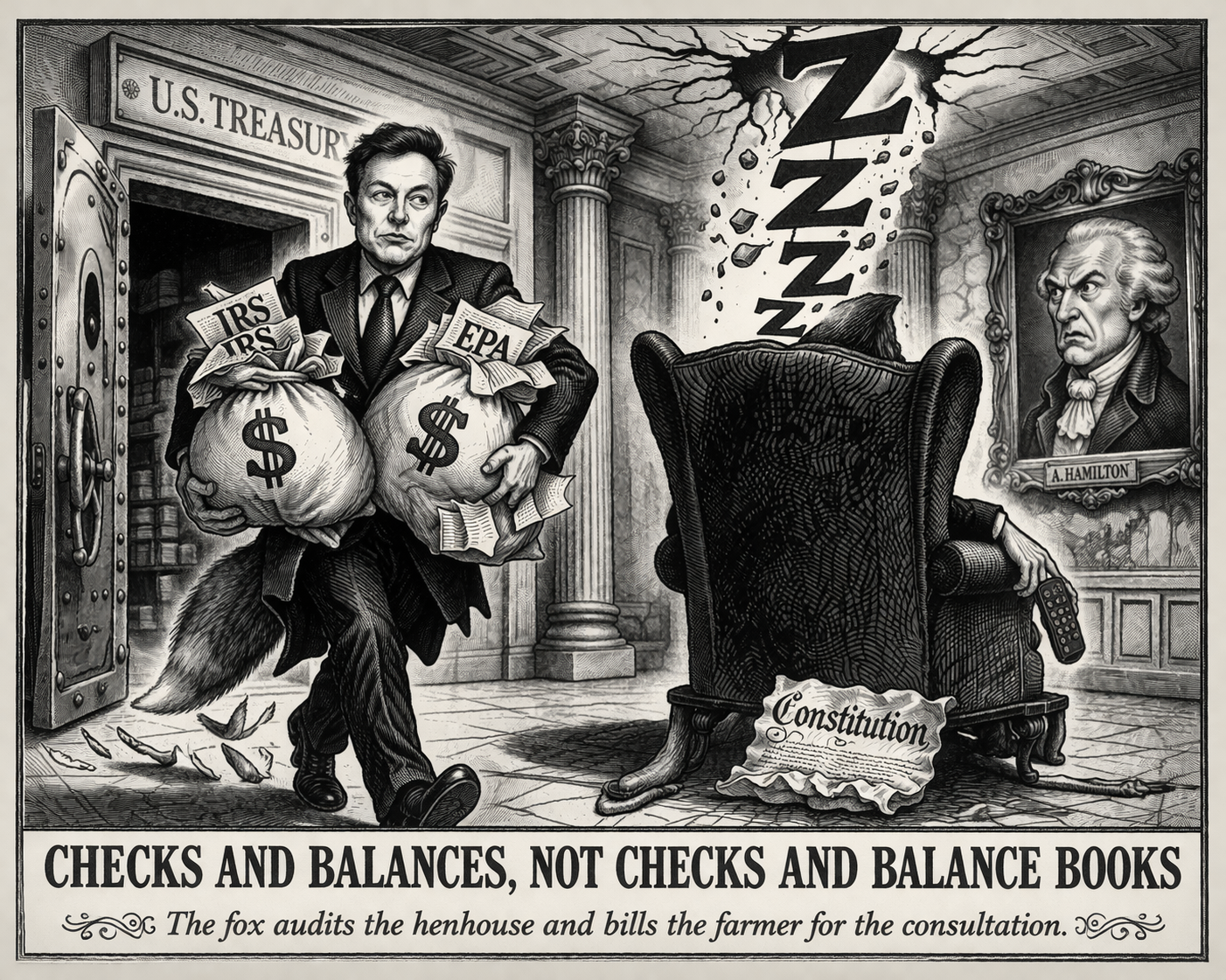
One does not mend the harness while the highwayman has his pistol at the coachman’s head. One deals first with the pistol.
TIME magazine reports that American women have voted at higher rates than men in presidential elections for decades, and that women’s voting rights are now under direct threat precisely because of the effectiveness of their participation. I am asked to find this paradoxical. I do not. I understood it in 1776. Power does not share itself. Those who exercise it will always seek to restrict the franchise of those whose votes threaten their hold upon it. The suppression of women’s political participation is not a side effect of the authoritarian project. It is a load-bearing wall. Remove women from the electorate, or sufficiently discourage their participation, and the structure of minority rule becomes stable. Leave them in, and it does not.
This is why the Brennan Center for Justice argues that the erosion of women’s rights and the erosion of democracy are not parallel phenomena occurring by coincidence. They are the same phenomenon. They have always been the same phenomenon. The only novelty of the present moment is that we now possess institutions in Gothenburg and London that can assign decimal values to what I could perceive with my own eyes from Braintree, Massachusetts, two hundred and fifty years ago.
The 19th News reports that when voting rights are threatened, women show up. That attempts to restrict ballot access make democracy personal rather than theoretical. That historically marginalized groups experience voter suppression not as a policy dispute but as an assault on their humanity.
I could have told them that. I did tell them that. The letter is dated March 31, 1776. Nobody listened.
Where We Are Going.
That is the question, is it not? The one to which no Spirit and no scholar and no index can provide a certain answer.
The research coming out of the University of Birmingham finds that when a democracy falters, it very rarely recovers fully, and most recoveries do not last even five years. The analysis in Foreign Affairs by Professors Levitsky, Way, and Ziblatt finds that the United States has entered the territory of what political scientists call competitive authoritarianism, meaning the forms of democracy persist while the substance is hollowed out, but that channels of contestation remain open and the decline is, in principle, reversible. The V-Dem researchers find that among the nations currently turning back toward democracy after a period of decline, the common factor is sustained mass mobilization. Not a single march. Not a hashtag. Not an election-year surge. Sustained, frequent, long-standing insistence by ordinary people that the government answer to them.
I take particular note of that finding.
I was not permitted to vote. I was not permitted to hold office. I was not permitted to own property in my own name, to appear in court without my husband’s representation, or to sign a contract. I was, by the legal and political conventions of my time, a non-person in the public sphere. And yet I managed, through the means available to me, to exert influence upon the founding of a nation. I do not say this to boast. I say it because the women reading these words today possess instruments of participation that I could not have imagined in my most extravagant correspondence, and the question before them is whether they will use those instruments with the same ferocity that their foremothers brought to a fight they waged with far less.
The women who fought for suffrage were dismissed as unreasonable. They were arrested. They were force-fed in prison when they refused to eat. They were ridiculed in the press and erased from the histories their labor made possible. They did not have a Democracy Index to consult. They did not need one. They understood, in their bones and in their daily experience, that the democracy they had been promised existed only on paper, and that paper promises are redeemed only by those who insist upon payment.
I observe that the year 2026 marks the 250th anniversary of the Declaration of Independence. I observe that Ms. Magazine has chosen this anniversary to convene a summit dedicated to women’s power and democratic design. I observe that the timing is not a coincidence.
Two hundred and fifty years ago, my husband and his colleagues declared that all men are created equal, and they meant it quite literally. Men. Propertied men. White, propertied men of a particular station. The subsequent history of this Republic has been, in its best chapters, the story of how that circle was widened; slowly, painfully, incompletely, and always against the determined resistance of those who preferred the circle as they found it.
We are told the circle is contracting again. We are told the democracy is flawed. We are told the score has dropped and the speed of the fall is without precedent in the modern record. We are told that the institutions designed to check executive power have largely declined to do so. We are told that the press, the academy, and the courts are under sustained assault. We are told, in sum, that the thing our foremothers built at such extraordinary cost is being dismantled with the casual efficiency of men who believe they will never be held to account.
Very well. We have been told. Now we must decide what we intend to do about it.
I will tell you what I intend to do.
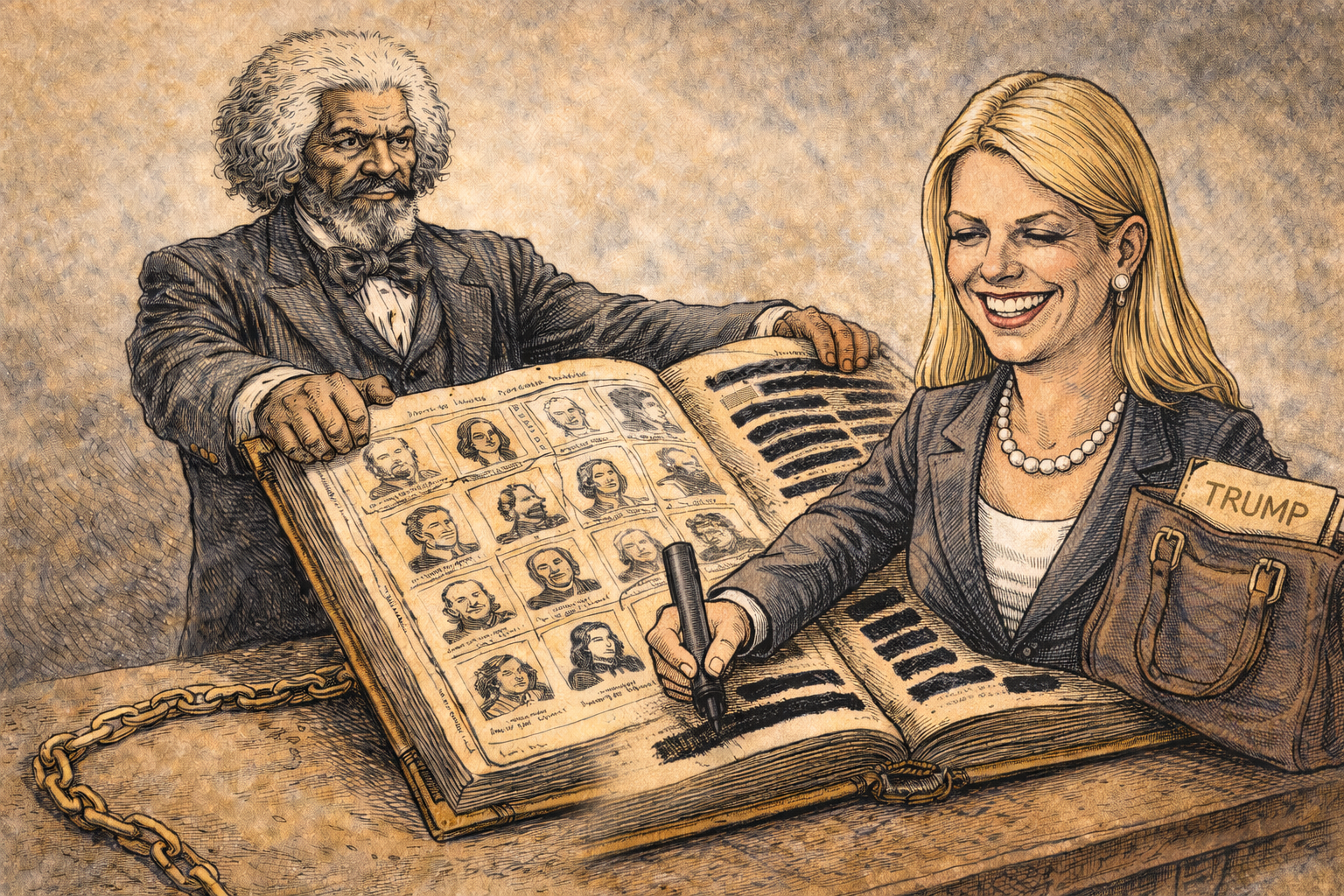
I intend to use this publication, and the voices of seventy-six Spirits who understood the cost of self-governance because many of them paid it with their lives, to insist that the American experiment is not concluded. I intend to publish, and to agitate, and to remind, and to refuse the comfortable silence that permits the unthinkable to become the routine.
I intend to remember the ladies. Not as an invocation. Not as a slogan. As a practice.
I remember the suffragists who were arrested for the crime of believing they were citizens. I remember the women of Seneca Falls who were told they were hysterical for demanding what men had always assumed was theirs by right. I remember the women who crossed the Edmund Pettus Bridge and were beaten for the presumption that their votes should count. I remember the women who stood in silent vigil outside the White House, holding signs that asked why a president who fought for democracy abroad could not abide it at his own front gate.
And I remember the mothers of Minab, who were on the road to collect their daughters when the roof came down.
I remember all of them, because they are connected by a single thread that runs from my letter in 1776 to this publication in 2026: the understanding that when men consolidate power without restraint, it is women and girls who pay the first and the heaviest price. It was true when John laughed at my code of laws. It was true when the suffragists were imprisoned. It was true when the Voting Rights Act had to be passed because a century of constitutional promises had proved insufficient. And it is true now, when the abuse of girls can be buried under the killing of girls, and a nation can be asked to look away from both.
I will not look away.
Ms. Magazine asks what this moment requires of us. I will answer.
It requires that we stop treating democracy as something we possess and begin treating it as something we do. It requires that we stop waiting for institutions to save us and begin saving the institutions ourselves, or building new ones where the old have failed. It requires that we vote, yes, but that we also organize, litigate, march, write, teach, and refuse. It requires that we understand, as the suffragists understood, that the rights of women are not a subsidiary concern to be addressed after the larger crisis has passed. They are the crisis. They have always been the crisis. A republic that does not protect its daughters, whether from predators in penthouse suites or from missiles that find their schoolrooms, is not a republic worth the name.
It requires stubbornness. Not hope in the abstract, which costs nothing, but stubbornness in the specific, which costs everything and is the only currency that has ever purchased lasting change.
I wrote to John in 1776: “If particular care and attention is not paid to the ladies, we are determined to foment a rebellion.”
The particular care was not paid. The rebellion is two hundred and fifty years overdue. And I, for one, am not inclined to wait any longer.
I am Abigail Adams, one of 76 Spirits,
reconstituted and ready to fight to preserve the Republic.



Leave a Reply
You must be logged in to post a comment.