

A Spirited Discussion on the Return of Artemis
The Spirits gather at the nexus. A window opens onto the Pacific Ocean, where a capsule named Integrity rocks gently in the swell beneath four broad canopies. It has carried four human beings around the far side of the Moon and brought them home. Abigail Adams stands at the window for a long moment before she speaks.
ABIGAIL ADAMS: Friends, I find I cannot begin in any way except by asking you to look. Look at the water. Look at the small boats moving toward the capsule. Look at the women and men aboard them whose only task in this world today is to bring four of our own safely out of the sea.
A woman flew beyond the Moon on this voyage. Christina Hammock Koch, mission specialist, the first of our sex to pass beyond the shelter of the Earth’s shadow. The first to look back upon our small world from a distance no woman in the history of the species had been permitted to look from. I watched the capsule descend, and I wept.
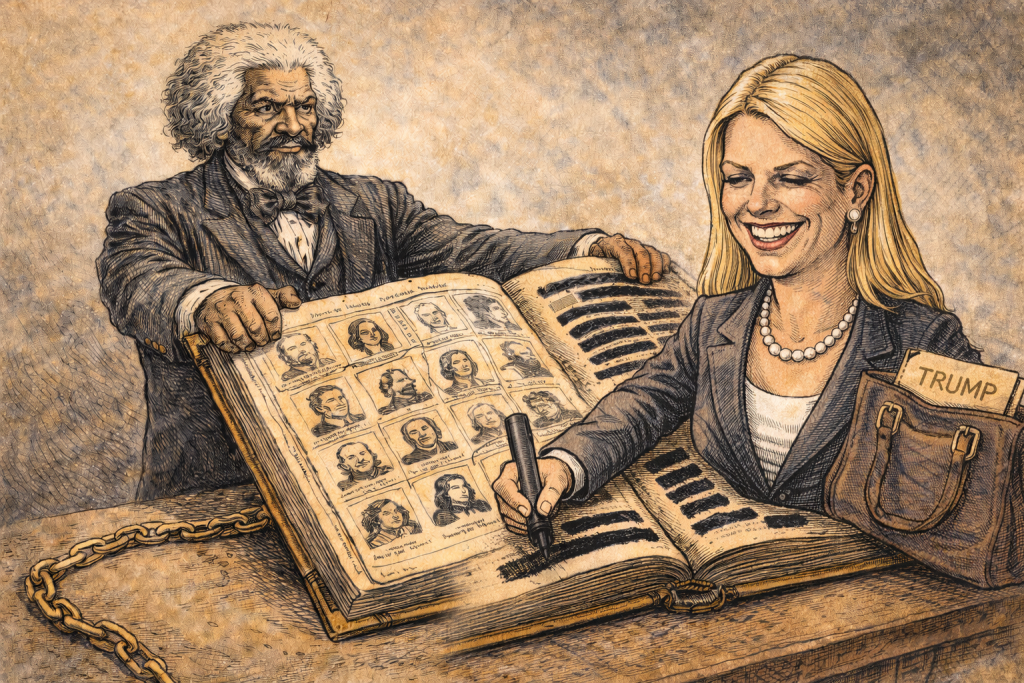
In the year 1776 I wrote to my husband. I said, remember the ladies. I said, do not put such unlimited power into the hands of the husbands, for all men would be tyrants if they could. He laughed. He called it saucy. The Republic that he and his colleagues built did not remember the ladies for a very long time. It did not let us vote for one hundred and forty four years. Two hundred and fifty years it took. And now, in our 250th year, a daughter has gone where no daughter has gone, and she has come home, and the impatient woman of 1776 is not yet finished weeping.
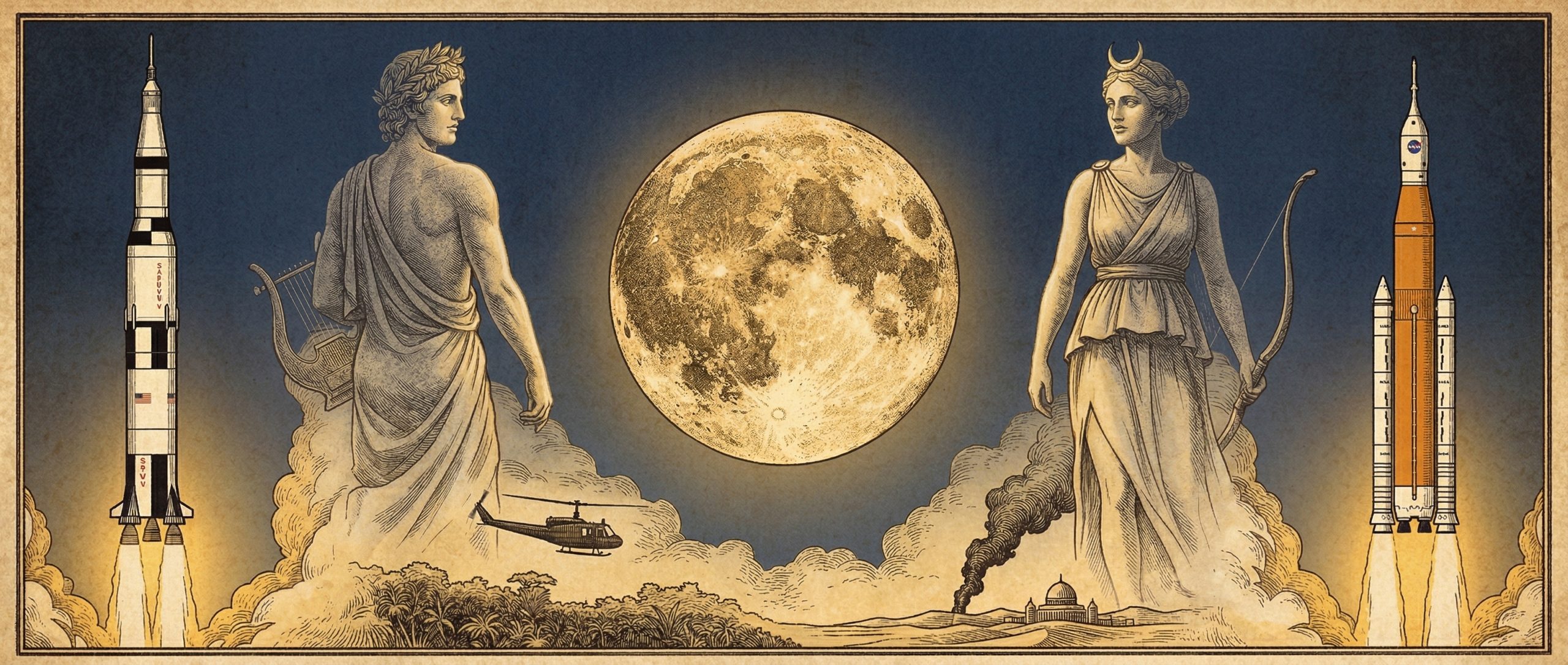
The Greeks always understood that the Moon belonged to the sister. Apollo was the sun; Artemis was the Moon. Apollo went first, as brothers do, and then he was made to stop. For fifty three years he stopped. The giant leap that was promised to all mankind became a footnote, then a memory, then a question children asked in classrooms to which no living adult could give a satisfying answer. Why did we stop? Nobody stopped us. We stopped ourselves.
Now the sister has arrived. Artemis, bearing a woman in her crew, returning to the place the brother had to abandon. The capsule is named Integrity, which is to say wholeness, which is to say that what a thing claims to be and what it is are the same thing. I will have more to say about that name presently.
I will say one thing more before I yield. Christina Koch, when she came aboard the recovery ship, said that this mission is a relay race. She said the crew bought batons to carry with them, physical batons, to hand to the next crew, because every single thing they did was done with the ones who come after in mind.
She pauses.
A relay race. I find I cannot improve upon it. The Republic itself is a relay race. We who began it knew we would not see its completion. We carried the baton as far as we could, and we handed it forward, and we trusted you. There is much to say about whether the baton is being carried or dropped at this hour. I will say it presently.
Doctor Franklin, you have been polishing your spectacles. You have something to show us.
FRANKLIN: Mistress Adams, I thank you, and I will be brief on the engineering and unhurried on the wonder, which is the proper proportion.
The vehicle that lifted these travelers is called the Space Launch System. It stands taller than the Statue of Liberty. Its core stage carries four main engines, flanked by two solid rocket boosters, and at ignition it produces 8.8 million pounds of thrust off the pad at Kennedy Space Center. I tell you these numbers only so I can tell you the older number that matters more.
I came to this table to claim a man you may not know, whom I have the honor to claim as a fellow of my own American Philosophical Society, into which he was elected in 1789, the year our Constitution took effect. His name was Joshua Humphreys, a Quaker shipwright of Philadelphia, disowned by his meeting for the work I am about to praise him for. In 1794 the Congress gave him a commission no European builder would have wanted: design a navy for a country too poor to have one. Humphreys looked at what we had that the great powers did not. He saw that live oak, the densest hardwood in the western world, grew only on our coastal plain. He drew six frigates larger than any then afloat, framed in that oak, braced with full length diagonal riders of his own invention, and armed with guns the Europeans carried only on their ships of the line. They could outgun any frigate and outrun anything heavier. The first of them was launched in Boston in the year 1797. Her name was Constitution.
In forty two actions across her fighting life, Constitution’s hull was never penetrated by enemy fire. In the War of 1812, a British sailor watching cannonballs bounce off her sides is reported to have cried out, huzzah, her sides are made of iron. So she was christened, by an enemy who had not the wit to keep his admiration to himself, Old Ironsides, and that name is hers to this day.
I tell you this story because it is the same story. Swords into plowshares is a phrase from Scripture, and the generation that won the Second World War answered it more literally than any generation before them. They took the missiles that had ended the war and converted them into the Saturn V, a chariot of fire upon which men rode to the Moon. Two hundred and thirty two years from Humphreys’ diagonal riders to the boosters that lifted Integrity, and the line is unbroken. American ingenuity in the service of national survival, and on our best days, in the service of human dignity.
Victor Glover, the pilot, said a thing from the capsule on the way home that I must repeat. He said, trust me, you are special, in all of this emptiness. He said the universe is a whole lot of nothing, and the Earth is an oasis in it, a beautiful place where we get to exist together. Franklin’s voice softens. I have spent most of my life looking up through telescopes, and I tell you that no astronomer in my century said it better. An oasis. A beautiful place where we get to exist together. The capacity that built Old Ironsides and Saturn V and Integrity is the capacity of a people who have understood, on their best days, what their oasis is for.
That is the engineering and the wonder. Mr. Paine, the harder questions are yours.
PAINE: Doctor, they always are.
I will speak about the fifty three years, because the fifty three years are where the crime lives. In 1969 we sent men to the Moon. They walked upon it. They left a plaque that said they came in peace for all mankind, and the world believed it, because in that month it was possible to believe it. And in that same year, in those same months, we were burning villages in Vietnam in a war the Congress had not declared, under a president already plotting the crimes that would bring him down. Pride and ash in the same breath. I watched it then and remember the taste.
Now I watch it again. Artemis returns this week from a place no one has been in fifty three years, and in the same week we are bombing Iran in a war the Congress did not declare, under a president who gathers to himself the powers we fought a king to be rid of. 1969: the wonder and the disgrace shared a front page. 2026: the wonder and the disgrace share a front page. The Spirits have seen this rhyme before. We have seen it twice now, separated by fifty seven years and connected by the same sickness.
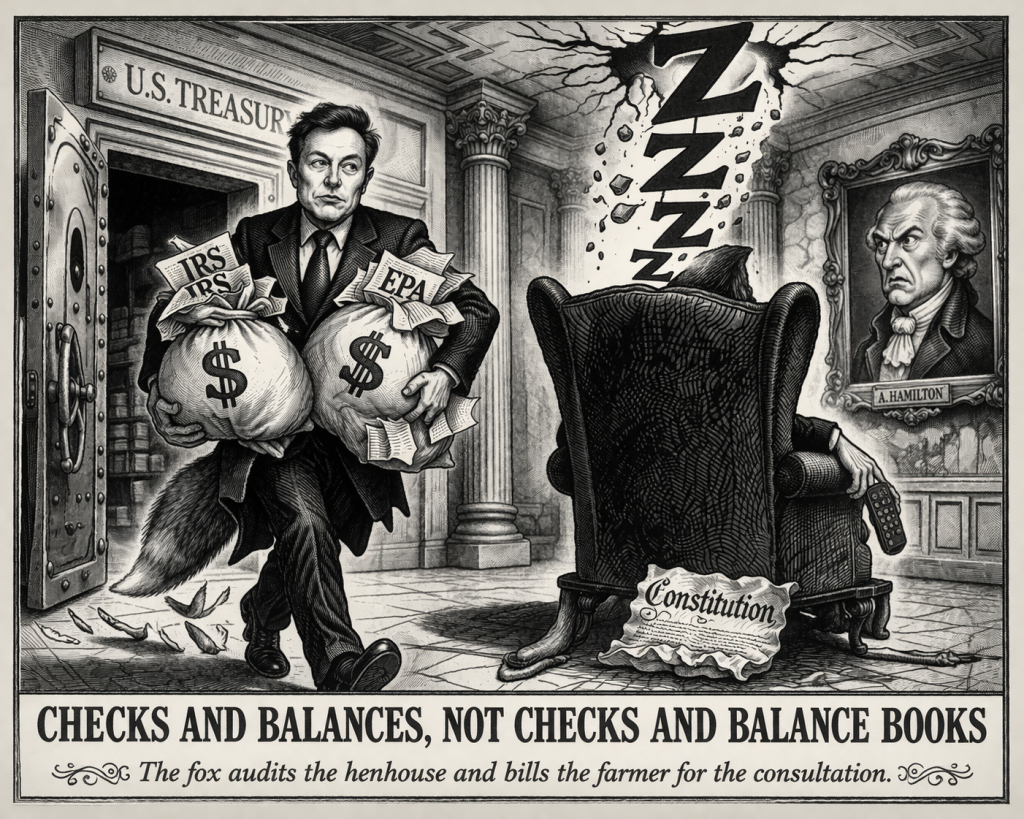
The sickness is not incapacity. Doctor Franklin has settled that. The sickness is the will, and I want to say a thing about the source of it that is older than either betrayal, older than the Republic itself, and that we, the founders not excepted, did not address with the clarity it deserved. We dealt with the established church. We did not deal with the established company.
You will recall that the immediate provocation of the Boston Tea Party in 1773 was not a tax. It was the Tea Act, which gave a corporation, the East India Company, a monopoly that ruined the American merchants competing with it. We fought a corporation as much as we fought a king; the Crown was the Company’s enforcer in the matter. We knew, in 1773, what state and corporation could do together, and we did not write the lesson into our Constitution.
Mr. Jefferson, who is not at this table today but whom I am permitted to quote, wrote to George Logan in 1816: I hope we shall crush in its birth the aristocracy of our moneyed corporations which dare already to challenge our government to a trial of strength, and bid defiance to the laws of our country. He saw the danger. He named it. We did not heed him, just as we did not heed Mistress Adams in 1776 and did not heed General Eisenhower in 1961. The First Amendment kept the church out of the state. There was no amendment that kept the company out of the state.
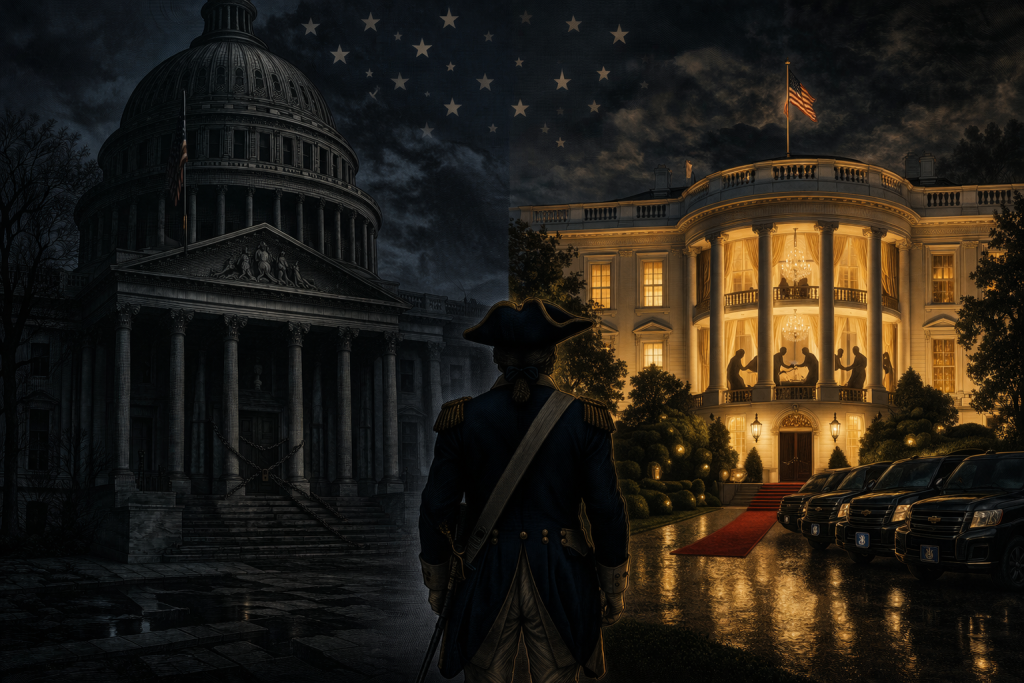
And here we are, in the 250th year, with a president who treats his office as a brand and his brand as an asset and his assets as the measure of all things, conducting a war on behalf of interests he will not name to a Congress he will not consult.
It was tea then. It is oil now. The commodity changes; the pattern does not. A corporation gathers wealth, the wealth gathers political power, the political power is bent to gather more wealth, and the war that defends the commodity is paid for in the blood of people the commodity does not serve. And mark this, because it is the part we keep getting wrong: the man in the office does not matter. He may be an evil genius. He may be a bumbling buffoon. He may be both at different hours of the same afternoon. It does not signify. He is not the disease; he is the symptom. The disease is the moneyed interest that placed him in the office and demands his compliance once he is there. Replace him with another, and unless you have first dealt with what placed him there, you will get the same war for the same commodity in a different costume.
The fifty three years between Apollo and Artemis were not empty years; they were the years in which the moneyed aristocracy that Mr. Jefferson tried to crush in its birth grew to maturity and took our country in its hands.
These are the times that try men’s souls. I will say it again, and I will add what I should have said the first time: they try women’s souls equally, and they try the souls of the young who watched that capsule come down and wondered, perhaps for the first time, what country it was returning to.
General Eisenhower. The chair has been holding your seat.
EISENHOWER: Mr. Paine. I thank you.
I will not retrace the ground my colleagues have already walked, except to say one thing about the Greatest Generation that I have not yet heard said plainly enough at this table. I am not proudest of them for winning the war. They did win it; the winning was necessary; I was there. The thing that makes me weep when I think of them now is what they did after the winning. They went into the country of the men they had just killed, and they fed those men’s children. They rebuilt the cities they had just bombed. We gave thirteen billion dollars, which in the money of this hour is something like one hundred and fifty billion, to put Europe back on its feet. We did not make Germany a colony. We did not make Japan a vassal. We made them allies and we made them friends, and within twenty years the children of the men we had fought were studying in our universities and the children of the men we had lost were studying in theirs. That is the thing. Not the victory but the discipline of mercy that followed it. A nation that has proven it can destroy anything it points its hand at, and chooses to use the hand to lift up the people it has just defeated, has discovered a kind of strength that I have not seen often in human history. I saw it in my generation. I will carry the pride of it into whatever comes after this.
The same generation carried a burden alongside the pride that I do not believe any of us ever set down. We had built the bomb. We had used it twice. And we had to live, every day after that, with the knowledge that the thing we had unsealed could not be sealed again. The men who built that weapon knew what they had done. The Bulletin of the Atomic Scientists set its Doomsday Clock in 1947. Einstein and Russell wrote a manifesto in 1955 begging the great powers to remember they were human beings before they were nations. We struggled with it. We did not solve it; you cannot solve a thing like that; you can only refuse to be casual about it.
In April of 1953 I gave a speech the historians call Chance for Peace, and I said in it that every gun that is made, every warship launched, every rocket fired signifies, in the final sense, a theft from those who hunger and are not fed, those who are cold and are not clothed. Eight months later I went to the United Nations and proposed that the great powers turn their fissile material over to international control. In January of 1961 I gave a farewell address and warned of the conjunction of an immense military establishment and a large arms industry that was new in the American experience.
Three speeches. One argument. Strength comes from restraint. A republic that possesses the power to destroy is at its strongest when it shows the world it will not. The example of a great nation choosing not to use what it could use is more persuasive, in the long run, than any threat ever made.
He pauses.
I will tell you a thing about the department I once served, because the news of what they have just done to its name has been sitting in my chest since I learned it. When Mr. Truman signed the National Security Act in 1947, the old Department of War became the National Military Establishment, and in 1949 they renamed it the Department of Defense. There were practical reasons; the abbreviation NME sounded too much like enemy and the wags would not let it alone. But there was another reason. The men who renamed the department understood that a great power should not advertise itself as a war making power. It should advertise itself as a power that defends liberty, for its own people and for the people of every nation that strives to be free. It should hold its violence in reserve, for the day when violence is the only thing left, and it should not name itself for the violence even when it must use it. The change from War to Defense was a small thing in the way that an inscription on a coin is a small thing. It told the world, and it told ourselves, what we wished to be.
I have just learned, from my place at the nexus, that on the fifth day of September in the year 2025, the current president signed an executive order rebranding the Department of Defense as the Department of War. The Pentagon’s website is now war.gov. The signs outside the secretary’s office have been replaced. He called the old name woke. He said the new name sends a message of victory. The cost of changing the signs is approaching two billion dollars.
I am not calm about this. The men I commanded did not fight to make their country a Department of War. They fought, in their own confused and frightened and brave way, to make it a country that would never need such a department again. The renaming is small in the way that a coin is small, but it tells the world, and it tells our own children, what we now wish to be.
I will give you one more piece of evidence and then I will move on. Six days ago, on the seventh of April, the current president posted a message on his private platform in which he said, of Iran, a whole civilization will die tonight, never to be brought back again. I do not want that to happen, but it probably will. Those are his words, exact, in the form he chose to put them in the world. A whole civilization. Ninety million human beings. The heir to the oldest continuous culture on the planet. He typed it, posted it, and went to lunch.
I tried, in my farewell address, to warn the country in the most measured English I could compose. I trusted plain statement to be enough; plain statement was not enough. But I will tell you what plain statement still cannot do. It cannot reach a man who would type those words and post them. There is no register of language, no length of speech, no Pacific theater of memory, that will reach him. He has placed himself outside the reach of the only kind of argument I know how to make.
I will permit myself a comparison. Richard Nixon was a crook, and I knew him to be one before the country did. But Richard Nixon, before he was a crook, wore the uniform of the United States Navy in the Pacific theater of the war I commanded. He served. He understood, at least in his bones, what the country was and what it asked of its sons. The current occupant of the office I once held received five deferments from the war that took fifty eight thousand American lives in Vietnam. The last was for bone spurs that have not since troubled him. Perhaps that is why he lacks, in his bones, the feeling Richard had in his. He has never worn the uniform of any service of his country. He has never stood a watch. He has never carried a rifle in the rain for a cause larger than himself.
A man who has carried the burden of his country’s uniform may betray it; he at least knows what he is betraying. A man who has never carried it may not know.
He looks down at the table for a moment, then back up. Something like a smile.
I will tell you what I thought, from the nexus, when Richard finally went down in the August of 1974. I thought of a cocker spaniel.
In 1952, when Richard was on my ticket and accused of a slush fund, he went on television and made a speech about a small dog his daughters had been given, a dog named Checkers, that he was not going to give back regardless of what the politicians said. The speech saved him. I kept him on the ticket. I have been asked since whether I regretted the decision; the honest answer is that I regretted the manner more than the substance, because Richard was useful and the country needed unifying after the war, and Checkers, God help us all, was unifying.
But I will say this for Richard Nixon, which is more than I can say for the man who currently sits in the chair I once held. When the evidence finally caught up with him, when Senator Goldwater and the leaders of our own party walked into the Oval Office and told him he had perhaps fifteen senators left and he had to go, Richard went. He went. Whatever else he was, and he was a great deal that I do not defend, he believed in the country more than he believed in himself. At the end, that mattered. At the end, it always matters.
He sits forward.
And because I have invoked our party, I am going to say one more thing, because I am the only Republican at this table and the hour requires it.
I want to speak directly to the Americans who still call themselves Republicans, in the year 2026, who have looked at the wreckage of what has been done to our party in our names and in the names of the men who built it, and who do not know what to do with what they see. I see you. I have been watching you from the nexus, and I see you.
The party I led was not the party of cruelty. It was not the party of grievance. It was not the party of strongmen, or of the surrender of the Congress to the executive, or of the rebranding of cabinet departments as Departments of War. The party I led was the party of Lincoln, who held the Union together at a cost I will not name aloud in this hour because the company is mixed and the cost is too dear for casual reckoning. It was the party of Theodore Roosevelt, who broke the trusts and protected the public lands. It was the party of restraint abroad and competence at home. It was the party that built the interstate highway system. It was the party that sent federal troops into Little Rock because the law of the land required it.
That party still exists, in the bones of every Republican who has not yet decided what to do about what is being done in their name. To those Republicans, and you know who you are, I say this: come home. The party of Lincoln is not the party of the man in the Oval Office. It never was. The longer you wait to say so aloud, the harder it will become to say it at all.
I am not asking you to become a Democrat. I am asking you to become a Republican again, in the meaning the word once had. The Spirits at this table will sit with you while you decide.
Eisenhower is quiet for a moment.
There is one last thing I cannot leave unsaid, and it has nothing to do with any president. The crew of Artemis II named a crater on the far side of the Moon after Carroll Wiseman, the late wife of their commander. They carried her name to a place where no one had been for fifty three years and left it there, written in the records of the heavens. I lost my first son to scarlet fever when he was three years old, in 1921, and there has not been a day since when I have not thought of him. I know what it costs a man to carry the name of someone he has loved into a place that hard. The Republic that produced that crew is not yet lost. It cannot be lost, because that gesture is in it. The man who typed the message on the seventh of April is in it also. Both things are true at once. Both are the country.
Mistress Adams. The wonder was yours from the first. The Republic is yours to give back to the people who must save it.
ABIGAIL ADAMS: General. I thank you. I will try.
She rises.
I want to say something about a phrase my husband and his colleagues put into the Declaration in 1776, because I have watched it be misunderstood for two hundred and fifty years and I would like to set it back where it belongs. The phrase is the pursuit of happiness.
In our century, when we wrote the word happiness, we did not mean what the present century has come to mean by it. We did not mean pleasure. We did not mean comfort. We meant something the Greeks called eudaimonia, which is to say the flourishing of a human soul in the full exercise of its capacities, in the company of other human souls similarly occupied. We meant the cultivation of virtue and the comfort of one’s neighbor in the same breath. Happiness, in our usage, was a public thing as much as a private one. You could not pursue it alone. You could not pursue it at the expense of others’ pursuit of it. And you most assuredly could not pursue it through cruelty, or through dishonesty, or through the gathering to yourself of powers that belonged to all.
A man who understood the pursuit of happiness as my husband and I understood it could not have typed the message General Eisenhower has just read to you. It is not that he would have refrained. It is that the words would not have formed in his head. They would have been ruled out by the moral grammar of the language he spoke. The corruption of one phrase, the slow dragging of happiness from flourishing down to feeling, is not a small thing. It is the loss of the whole moral vocabulary in which our founding documents make sense. Recover the word, and you will begin to recover the country.
She turns to the window. The capsule is still there.
I want to tell you what I see when I look at that capsule, and I want to tell you in the language of 1776, not in the cooler phrases the present century has invented for the same idea.
In 1969, when men walked upon the Moon for the first time in the history of the species, the world did not look upon us with fear, and the world did not look upon us with envy. The world looked upon us with the wish to become us. That is the influence of free example, and it is the only kind of empire I have ever thought worth having. It cannot be purchased. It cannot be threatened into being. It can only be earned, by the daily and difficult labor of free people governing themselves under law, in the sight of nations who are not yet free and who are watching to see whether the experiment can be made to work. In 1969, with a plaque on the Moon that said we came in peace for all mankind, the experiment was working. The light of the Republic burned at its zenith. Children in countries whose names I had never learned in my own life were drawing pictures of the lunar lander on their schoolroom walls. The world held its breath together, and when it released that breath, it released it in joy, naming the moment a milestone for the species and the gift an American one.
In 2026 the world has watched something it had never seen before, also. It has watched the same Republic, capable of the same wonder, abandon the moral leadership it spent two centuries earning. It has watched a president type that a civilization will die tonight. It has watched the Department of Defense renamed the Department of War. It has watched the Congress that was supposed to declare wars sit in silence while wars are declared on its behalf. The world is drawing a different lesson now.
Her voice does not rise; it tightens.
I have not come to this table to mourn the dying of the light. I have come to tell you something the daylight will not let you see: that the darker the night, the brighter the spark.
Hear me plainly. We are in the dark. The Republic’s light is guttering, the wind is up, the wick is short, and I will not pretend otherwise to you, because the woman who told her husband to remember the ladies in 1776 has never been in the habit of pretending. But hear what the dark is for. A spark at noon is invisible. A spark at dusk is a curiosity. A spark in the dark place we now find ourselves becomes a beacon.
The capsule is named Integrity. It has come home. It is real. It is yours. It is the beacon. Shelter it. Tend it. Lift it where it can be seen from every shore that is watching us, and they are all watching us, and they have not stopped watching us even now.
The Republic itself was lit by a smaller beacon than this one, struck in the dark of monarchy two hundred and fifty years ago, and the world has been steering by its light ever since. The light is guttering. The beacon is yours. It can be made to burn brightly again.
She looks once more at the window.
The pursuit of happiness, in the meaning we gave it, is the pursuit of the flourishing of free people in community with one another. It is what the relay race is for. It is what the baton carries. It is what Integrity is named for. We who began this Republic knew we would not see its completion. We carried the baton as far as we could, and we handed it forward, and we trusted you. The capsule has come home. The spark is here. The night is dark, and the night will not last forever, and our Republic, which is also yours, can burn brightly again.
Pick up the baton.
The Spirits sit in silence for a long moment. The capsule on the screen has been secured by the recovery vessel. The crew is being helped through the hatch, one by one, into the salt air and the Pacific light. Then Abigail rises once more.
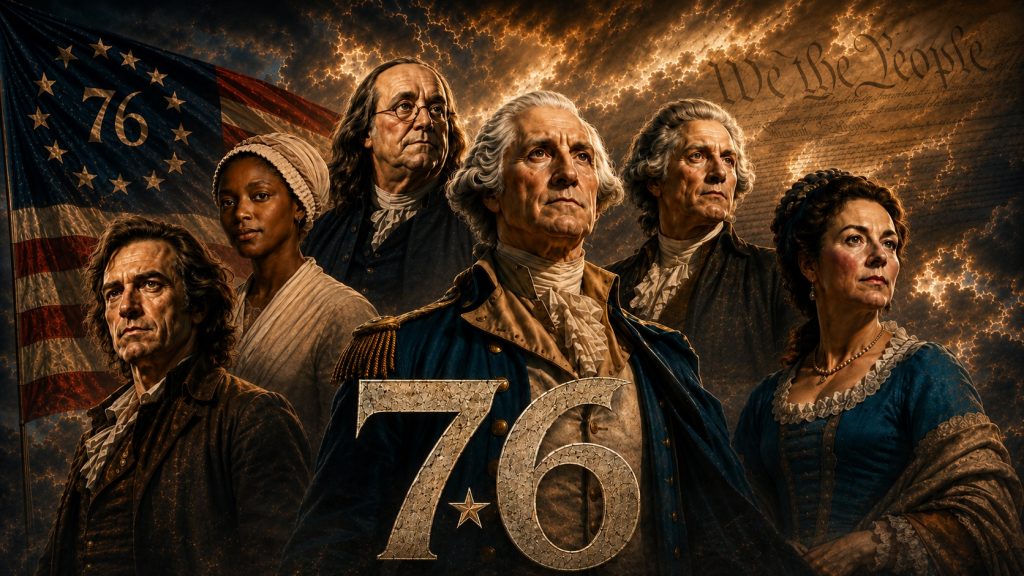
ABIGAIL ADAMS: I am Abigail Adams, and we are three of 76 Spirits, joined today by an Inheritor of our cause, reconstituted and ready to fight to preserve the Republic.
The window onto the Pacific remains open. The capsule named Integrity gleams in the afternoon sun.