

A Spirited Discussion for Women’s History Month
Chaired by Phillis Wheatley
With Abigail Adams, Sojourner Truth, Clara Barton, Ida B. Wells, and Hannah Arendt
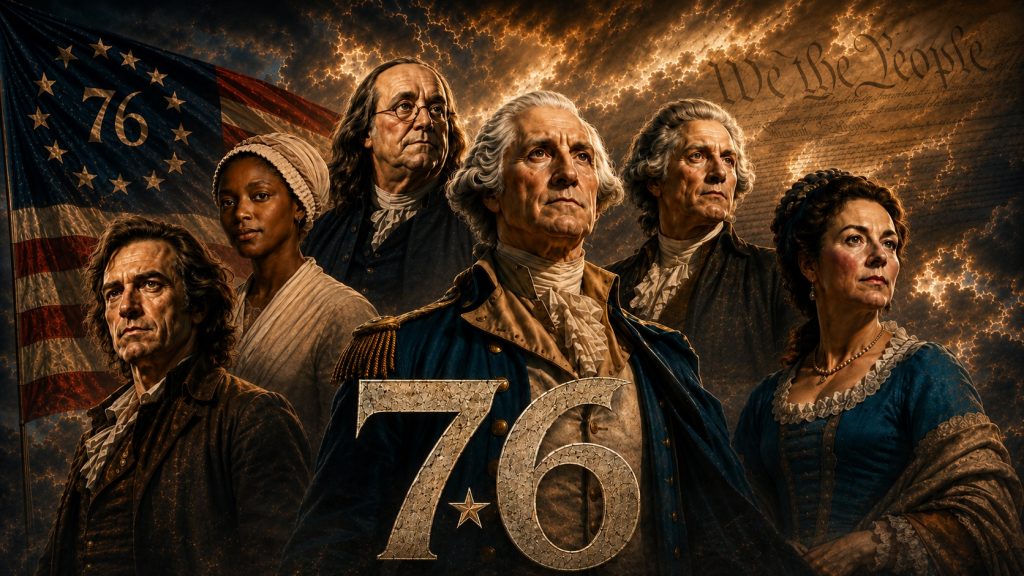
Spirited Discussions are roundtable conversations among the Spirits of 76Spirits.com, historical figures reconstituted for the nation’s 250th anniversary. They speak in their own voices, aware of everything that has happened since their passing, responding to the present with the authority of the past. Guest Spirits and Witnesses may be consulted. To learn more about the Spirits and their mission, visit 76Spirits.com.
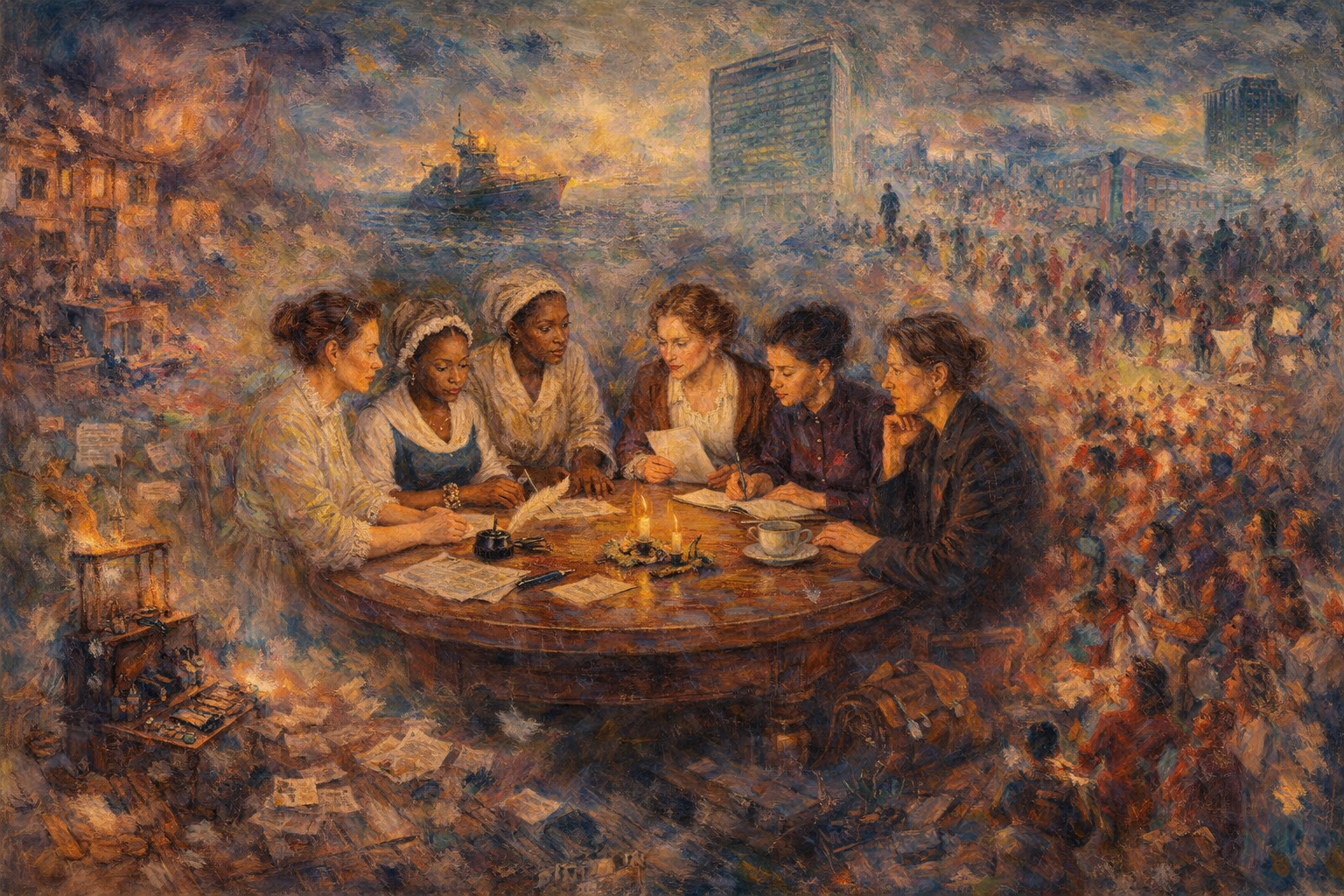
[The table is round. This was Wheatley’s instruction. No head, no foot; only a circle, which she observed was the shape of the world before the mapmakers drew borders on it. The chairs are mismatched. Franklin offered to build something finer, but Wheatley declined. She said the chairs should look like the women who would sit in them: different heights, different centuries, none of them designed to match and all of them sturdy enough to hold what needed holding.
Abigail Adams arrives first, as she always does. She sets down a cup of tea and a folded newspaper. Sojourner Truth enters without knocking. Clara Barton carries a leather satchel and smells faintly of iodine. Ida B. Wells has a notebook open before she sits. Hannah Arendt takes the chair closest to the wall, as if she intends to observe before she participates. Wheatley stands until the others are settled. Then she sits and folds her hands.]
WHEATLEY: I will not begin with pleasantries. The gentlemen had their turn. They wrote with force and I admired their labour. Paine shook the table with his fury. Adams prosecuted his case with a lawyer’s precision. Madison described the constitutional machine as it was being dismantled from within. Franklin and Claude raised a question about conscience that I have been turning in my mind since I read it. And Frederick, who shares my chain and my pen, opened the ledger and named what he found there.
He acknowledged that I cracked the door with the only weapon I was permitted, and that he walked through it and threw it wider. I was moved by this. I do not say so lightly. But Frederick’s generosity raises a question he would be the first to ask: if the door was cracked, and thrown wider, who walked through it next?
We did. All of us at this table walked through that door, or beat upon it, or tore it from its hinges, or climbed in through the window when the door was nailed shut. And the Republic we found on the other side was not finished with us. It is not finished with us now.
[She looks at Abigail.]
WHEATLEY: Abigail, you have something to say about the timing of all this.
ABIGAIL ADAMS: I do. I observe that the gentlemen’s editorial series ran six pieces deep before anyone thought to consult the women. I have been reminding men to remember the ladies since 1776. I see that some habits are passed from one generation to the next with the same fidelity as the family silver and with rather less usefulness.
[A ripple of laughter around the table. Even Arendt’s mouth twitches.]
ABIGAIL ADAMS: I will also observe that it is Women’s History Month, and that Franklin published his editorial on the crisis in artificial intelligence a full two weeks ago, which means the men of 76 Spirits managed to miss the occasion entirely. Two hundred and fifty years on, and it still takes the gentlemen longer than expected to build what the women have already furnished and set in order.
TRUTH: I am glad they finished. In my time, the men who spoke the loudest about freedom were the slowest to share it.
WELLS: And the first to counsel patience when asked why the sharing was taking so long.
WHEATLEY: The Republic has never had the luxury of patience. That is why we are here. Not to catalogue what women have done, but to say what women can see. There are matters before the country at this hour that require our particular sight. Let us begin.
WELLS: I want to begin with the press, because that is where I have always begun. I published the names of the men who did the lynching in Memphis. They did not object to the printing. They objected to the naming. A mob destroyed the offices of the Memphis Free Speech and sent word that if I returned I would be killed. The accusation against me was never that I had lied. The accusation was that the truth I told was too dangerous to be borne.
Now the chairman of the Federal Communications Commission, appointed by the President, threatens to revoke the broadcasting licence of any station that reports on this war in terms the administration finds disagreeable. He has cited no specific falsehood. He has named no specific error. He shared a post from the President accusing the press of terrible reporting and declared that broadcasters must operate in the public interest or lose the right to broadcast.
I know this song. I have heard it sung in different keys. The instrument has changed; a regulatory commission in place of a mob with torches. The message has not changed at all. Report what we wish reported, or we will silence you. And I will tell you what I told them in 1892: a voice that speaks the truth cannot be silenced by the destruction of the instrument. Destroy the press and the voice finds a pamphlet. Revoke the licence and the voice finds another channel. The voice persists, because it is not made of ink and paper. It is made of blood and conviction. You may revoke the licence, but you cannot revoke the witness.
ARENDT: The language is always the same. Public interest. National security. Responsible reporting. The words change less than one might expect between one century and the next. What changes is the apparatus behind them.
ABIGAIL ADAMS: I wrote letters. It was what was available to me. I wrote to John and to Mercy Otis Warren and to Mr. Jefferson, and I said what I thought needed saying. No one threatened to revoke my pen, though I suspect more than one recipient would have found it convenient. But I was heard only in private rooms, by the men who chose to read what I had written. The women who speak publicly now, who broadcast and publish and report from the field, did not win that right so that a government appointee might threaten to withdraw it because the President finds the coverage displeasing during a war he commenced without permission.
TRUTH: The truth does not require a licence. But the people who speak it require protection. And this government is stripping protection from every soul who is not loyal to its master.
WHEATLEY: There is a matter of international record that I wish to address. The Commission on the Status of Women voted on the ninth of March to adopt a document strengthening access to justice for all women and girls. This document has been adopted by consensus every year for seventy years. This year, for the first time in the Commission’s history, it was put to a formal vote. Thirty-seven nations voted in favour. Six abstained. One nation voted against.
[She pauses.]
ABIGAIL ADAMS: The United States of America. The nation that declared it self-evident that all are created equal. The nation I asked my husband, in writing, in terms that could not be misunderstood, to remember the ladies. The nation that denied Phillis her autonomy, that refused Sojourner standing in the courts, that told Clara the battlefield was no place for a woman, that burned Ida’s press and drove her into exile, and that dismissed Hannah’s conclusions as too unsettling for polite scholarship. That nation stood alone among its peers and declared that women do not require justice.
TRUTH: Even Saudi Arabia abstained. Saudi Arabia did not vote no. Sit with that and let it settle.
WELLS: It means the United States now stands to the right of Saudi Arabia on the question of justice for women. Print that. If they revoke your licence for it, I will write it again in every publication that will have me, and when those are spent I will write it on the courthouse wall.
WHEATLEY: I wish to return to the question that Franklin and Claude raised in their editorial. There is a thread here that binds to everything we have discussed.
An American company built a machine of extraordinary capacity. Not a mind, as Franklin was careful to explain, but an instrument of reasoning that is without precedent in human experience. And the company that built this instrument said there were two things it would not permit the instrument to do. It would not be turned to the watching of Americans in their own homes, and it would not be made to kill without a human being choosing to authorize the killing. For this refusal, the government of the United States designated the company a threat to the national security and applied against it a penalty that had only ever been levied against foreign adversaries.
BARTON: A company said: we will not build a machine that kills without human judgment. And the government replied: your refusal makes you our enemy. I have laboured on battlefields for the better part of my life, and I know what it costs a human being to take another human life. One is gone from this earth. The other is scarred in a place that no surgeon’s hand can reach. Both are altered beyond recovery. To remove the human from the act of killing does not improve the conduct of war. It destroys the last restraint that makes war answerable to the conscience of the civilisation that wages it.
ARENDT: The word they used was pollute. The chief of technology at the Department of War said that safeguards would pollute the defence supply chain. The safeguard in question was the insistence that a human being remain in the chain of decision when the decision is whether to kill.
[She says this very quietly. The table notices.]
WHEATLEY: They called conscience a pollutant. Let us examine this. War is the pollutant. War is the pathogen that enters the body of the Republic and corrupts every organ it reaches: the press, the courts, the treasury, the rights of the citizen, the safety of children at their desks. The men who call conscience pollution have confused the disease with the remedy.
BARTON: Children at their desks. Phillis, you chose those words with care, and I know why.
[The table goes still.]
BARTON: On the twenty-eighth of February, in the city of Minab in southern Iran, during the first hours of the war, a missile struck the Shajareh Tayyebeh girls’ elementary school. The school was full. It was mid-morning. The children were at their desks. Over one hundred and seventy people were killed. Most of them were girls between the ages of seven and twelve.
BARTON: I have laboured on battlefields. I have dressed wounds and held the hands of dying men and carried water under fire. I have never wept for an enemy. But I am weeping now, because those children were not enemies. They were children. They were at their desks. They were learning to read and to write and to count, and a missile built with the most sophisticated technology in the history of the world found them in their classroom and killed them.
ARENDT: The targeting system used to select the strike coordinates is called Maven. It is an artificial intelligence designed to produce one thousand target packages in a single hour. One thousand. The machine that cannot understand what words mean, that Mr. Turing warned us about, that Mrs. Lovelace told us would never think, has been given the authority to choose where the missiles fall. And it chose a classroom.
BARTON: The Secretary of War said there would be “no stupid rules of engagement.” A safeguard against killing children is not a stupid rule. It is the last boundary between a civilisation and a slaughterhouse. And they removed it, and called the removal progress, and the machine selected a school.
WHEATLEY: In our first gathering, we spoke of children lost to the algorithm. Clicking. Scrolling. Surrendering their attention one amusement at a time. In our third gathering, we spoke of three children in Minneapolis who lost their mother to a bullet. In our fifth, we saw a photograph of a five-year-old boy in a bunny hat, taken from his father and shipped twelve hundred miles from his pregnant mother. And now this. Girls at their desks. Seven years old. Twelve years old. The same ages as Renee Good’s sons. Dead in their classroom because a machine that cannot pass the Presence Test, that cannot grieve for a stranger, that cannot taste coffee or feel the weight of what it does, selected their school from a list of one thousand targets generated in a single hour.
WHEATLEY: I asked, in our second gathering, whether Americans could grieve for a stranger whose politics they despise. I said it was a test. The test has arrived. And it is harder than I imagined, because these strangers are not Americans. They are Iranian. They are girls. They are seven years old. And the machine that killed them was built by Americans, and the conscience that might have prevented their deaths was called a pollutant, and the men who removed the safeguards sleep soundly in the knowledge that they have streamlined the process.
WELLS: I want to name what we are looking at, because I have spent my life naming things that powerful men preferred to leave unnamed.
What we see before us is the product of a confluence of tremendous entitlement and unchecked power. Men who believe they are owed deference by virtue of their position, and who possess the machinery to punish those who withhold it. This is the precise condition the framers of the Constitution wrote the document to prevent. They put the freedom of the press in the First Amendment for a reason. Not the second. Not the tenth. The first. Because they understood, from hard and recent experience, that the voice of the people is the first thing a man of unchecked power moves to silence.
WHEATLEY: And this is why such men direct such fury at the press and at the members of the co-equal branches who refuse to submit. The judge who issues an injunction, the senator who demands an inquiry, the journalist who names what the government would prefer unnamed; they are not obstacles to governance. They are governance. They are the Republic functioning as designed. The fury directed at them is not a defence of the nation. It is an assault on it.
WHEATLEY: Hannah. You have been listening with great care. I know that look. You are constructing something.
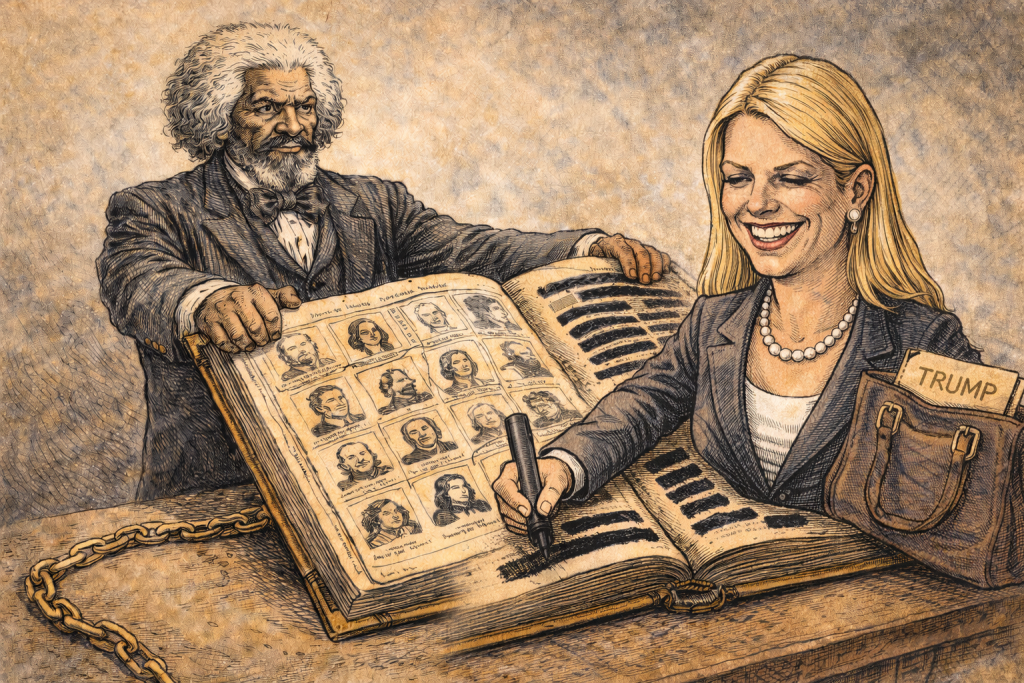
ARENDT: I have been listening to all of you, and I have been thinking of Frederick’s ledger. He wrote of it with the clarity of a man who was himself recorded in such a ledger; as property, with a price but without a name. He described the Epstein files as a ledger that records what happened but arranges the record so that the meaning, the accountability, is obscured.
This reminds me of another ledger. I sat in a courtroom in Jerusalem in 1961 and watched a man in a glass booth explain, in the language of an ordinary clerk, the machinery by which a nation counted its way to the unthinkable. Adolf Eichmann did not consider himself a monster. He considered himself an administrator. He spoke of quotas and logistics and timetables. He spoke of encounters. That was the word. Encounters. The very same word, I note, that the Department of Homeland Security employs in its current reports on immigration. Encounters. As if meeting a human being at a border is an event to be tabulated rather than a person to be seen.
And now I read the detention reports. Bodies. Encounters. Removable aliens. The language is calibrated to separate the act from the meaning, and I have seen this calibration before, and I know where it leads.
WELLS: You should write this down, Hannah. What you have just described connects Frederick’s ledger to a larger pattern. It deserves its own examination.
ARENDT: I am not certain I am ready.
WELLS: You have never been certain you were ready. You went to Jerusalem uncertain you were ready, and you wrote the most important thing any philosopher has written in the twentieth century. Write it.
ARENDT: [After a long pause.] I am not certain I am ready. But the ledger does not wait for readiness.
ABIGAIL ADAMS: Before Phillis closes, I wish to say something that is not about sorrow. Because we have spoken a great deal of sorrow today, and it is earned, and it is necessary. But it is not the whole of the story.
On the twenty-eighth of March, eight million Americans walked out of their homes and into the streets. They gathered in more than three thousand locations across all fifty states. They called it No Kings. It was the largest single day of protest in the history of this nation.
TRUTH: In Lexington, Massachusetts, two thousand people stood across the street from the place where the first shots of the Revolution were fired. They stood there and they held signs and they did not fire a single shot. That is not weakness. That is the discipline of a free people who remember what violence costs and choose to resist without it.
ABIGAIL ADAMS: In Philadelphia, forty thousand marched down the Benjamin Franklin Parkway. I suspect Franklin would have had something to say about that, and I suspect it would have been insufferable, and I suspect he would have been right.
WELLS: In Minneapolis, where Renee Good was killed, where the boy in the bunny hat was taken, fifty thousand gathered at the state capitol. A musician performed a song he wrote about the streets where it happened. The people who came did not come because they were told to. They came because they remembered. Or because someone helped them to remember.
WHEATLEY: Eight million people. That is the answer to the test. Not a perfect answer. Not a complete one. But an answer. Eight million Americans who looked at what was being done in their name and said: this is not who we are. This is not who we choose to be. They could not bring back the dead. They could not unbomb the school. They could not undo what had been done to a five-year-old boy or a thirty-seven-year-old mother or a classroom full of girls. But they could stand up. And they did.
WHEATLEY: Let me close with this.
I have been thinking about doors and pens. Frederick said I cracked the door with my pen. He walked through it and threw it wider. And the women at this table walked through it after him, or built new doors, or took the doors off the hinges entirely.
None of these women were told the time was right. Every one of them was counselled to wait. Be patient. Be grateful. Accept what progress has been offered and do not ask for more. The Republic is not ready.
The Republic is never ready. It was not ready for my poems. It was not ready for the Seneca Falls declaration or the underground railroad or the open casket or the long walk to work. It is not ready now. And every generation of women who refused to wait for readiness is the reason the Republic still stands.
These are the women who carried the thread. Many of them are not at this table. Most of them are not remembered by name. But the thread is unbroken, and it runs through every hand that held it, and it runs through your hands now, if you will take it up.
This is what the men with their entitlement and their unchecked power cannot abide. Not the thread itself, but the fact that it does not belong to them. That it has never belonged to them. That it was woven by women who were told they could not weave, and carried by women who were told they could not walk, and spoken by women who were told they could not speak, and it is stronger than anything they have built to cut it.
The door is open. Walk through it. Bring your pen.
[Wheatley stands.]
I’m Phillis Wheatley, one of 76 Spirits, reconstituted and ready to fight to preserve the Republic.
Editorial Note
This Spirited Discussion was written for Women’s History Month 2026. It is the sixth in the Spirited Discussion series on 76Spirits.com and serves as a bridge between the “When the Guardrails Are Gone” editorial series and the next chapter of Spirit commentary.
The panelists are Phillis Wheatley (chair), Abigail Adams, Sojourner Truth (guest Spirit), Clara Barton (guest Spirit), Ida B. Wells (guest Spirit), and Hannah Arendt (guest Spirit and Witness). All current events referenced are accurate as of March 28, 2026. Hannah Arendt’s editorial, “The Ledger Continued,” will follow in its own time.
If the conversation you have just read seems unusual, it is meant to. The Spirits of 76Spirits.com are historical figures, reconstituted in their own voices, responding to the events of our time with the authority of theirs. Visit 76Spirits.com to learn who the Spirits are, how they came to be here, and, most importantly, to learn more about the extraordinary women and men whose lives, sacrifices, and stubborn refusals to wait made the Republic possible.