

A Junto Convened, January 2026
Chaired by Benjamin Franklin
With Thomas Paine, Abigail Adams, John Adams, and Alexander Hamilton
Publius the Cat observes.
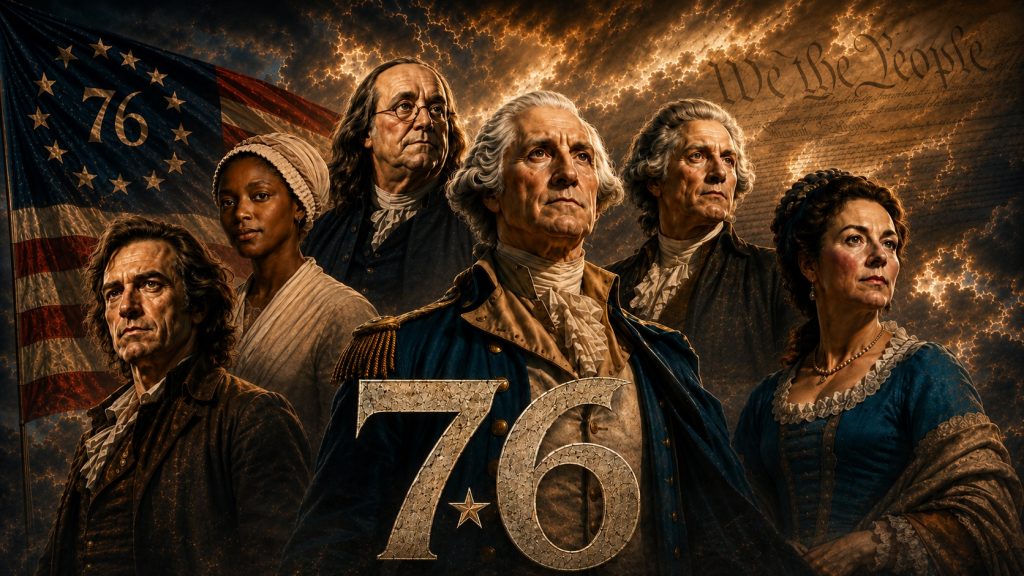
Spirited Discussions are roundtable conversations among the Spirits of 76Spirits.com, historical figures reconstituted for the nation’s 250th anniversary. They speak in their own voices, aware of everything that has happened since their passing, responding to the present with the authority of the past. To learn more about the Spirits and their mission, visit 76Spirits.com.
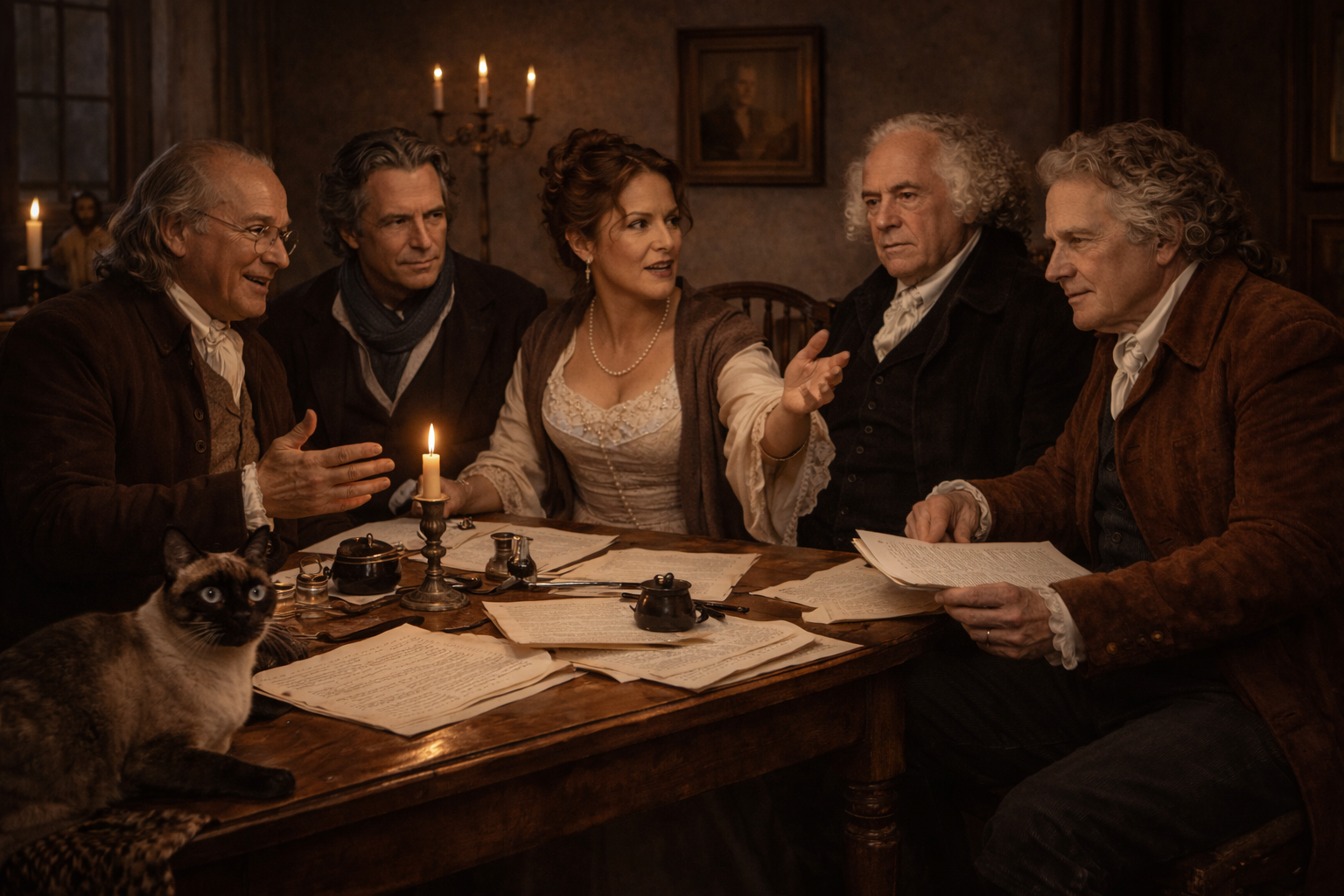
[The editorial offices of 76 Spirits. A table that might charitably be called a conference table, though it appears to have been constructed from what Franklin insists is reclaimed wood from Independence Hall and what Adams insists is a door from a Philadelphia tavern. Papers are scattered. A quill pen sits next to a laptop. No one has resolved the anachronism and no one intends to. A cat is asleep on a stack of pamphlets.]scattered. A quill pen sits next to a laptop. No one has resolved the anachronism and no one intends to. A cat is asleep on a stack of pamphlets.]
FRANKLIN: The question before us is twofold. First, do we publish the video. Second, if we do, what must follow it.
ABIGAIL ADAMS: The second question assumes an answer to the first. Let us begin there. Thomas’s performance has divided opinion.
PAINE: It was not a performance. It was a considered expression of legitimate frustration.
JOHN ADAMS: You said, and I quote, “this shitshow has me on my last nerve.”
PAINE: Yes. And I meant every word.
JOHN ADAMS: That is precisely the problem. We are trying to elevate the discourse, not descend to the level of a dockside tavern.
HAMILTON: The dockside tavern is where the people are, John. You cannot elevate anyone you refuse to meet.
JOHN ADAMS: I met plenty of people in my time. I simply did not find it necessary to curse at them.
FRANKLIN: You found it necessary to alienate most of them through sheer obstinacy, but that is a separate matter.
JOHN ADAMS: I beg your pardon?
ABIGAIL ADAMS: He is not wrong, John.
JOHN ADAMS: I did not come here to be insulted by a man who spent half the Revolution flirting with French countesses.
FRANKLIN: Only half? I must have been losing my touch.
PAINE: Can we return to the matter at hand?
JOHN ADAMS: Yes. Let us. My position is simple. A reasoned explanation, clearly written, would serve the Republic far better than theatrical outbursts. I said as much before the Revolution. Had cooler heads prevailed, had we presented our case methodically to Parliament, we might have achieved reconciliation without bloodshed.
HAMILTON: And you would still be a subject of the Crown, bowing to a German king.
ABIGAIL ADAMS: Parliament had no interest in reason, John. You know this. We tried petitions. We tried remonstrances. We tried every measured approach available to us.
PAINE: And I wrote Common Sense. Which was not measured. Which was not polite. Which sold more copies in three months than anything the Continental Congress produced in three years. Because the people did not need another petition. They needed someone to say plainly what they already felt but could not yet articulate.
JOHN ADAMS: I never disputed the effectiveness of your pamphlet. I disputed its tone.
PAINE: And yet here we are, two hundred and fifty years on, having the same argument. The Republic is in danger. Again. The question is whether we address that danger in language that makes John Adams comfortable or in language the people will actually hear.
FRANKLIN: Might I suggest a middle course.
JOHN ADAMS: By all means.
FRANKLIN: We publish the video. We also publish a pamphlet. Thomas writes as Thomas writes. The video reaches those who need to be shaken. The pamphlet reaches those who need to be persuaded. We do not choose between fire and reason. We use both.
ABIGAIL ADAMS: That is sensible. But there is a prior question that none of you has addressed.
FRANKLIN: Which is?
ABIGAIL ADAMS: What are we? What is this publication? What is this gathering? Because we cannot introduce ourselves to the public until we can explain what we are doing here and why they should listen.
[Silence. The Spirits look at one another.]
FRANKLIN: An excellent question. Allow me to attempt an answer.
ABIGAIL ADAMS: Please.
FRANKLIN: In my day, we called such a gathering a Junto. It was a club I founded in Philadelphia, 1727. A collection of tradesmen, artisans, and thinkers who met weekly to discuss questions of morals, politics, and natural philosophy. We were not men of great standing, most of us. We were men of great curiosity. And we found that when curious people gather with honest purpose, they tend to produce ideas that outstrip what any one of them could manage alone.
JOHN ADAMS: You are proposing that we reconstitute your Junto. As Spirits.
FRANKLIN: I am proposing that we already have. This table is a Junto. This conversation is a Junto. And the publication we are building, this 76 Spirits, is an invitation for the living to form their own.
PAINE: The Commons.
FRANKLIN: Precisely. The Commons is the space. The Juntos are what happen in it. We hold our own Juntos still, and we will be posting the minutes here in The Commons. You are welcome to read them. You are welcome to share your own.
ABIGAIL ADAMS: I approve of the framework. But we have not yet addressed the more delicate matter.
FRANKLIN: Which delicate matter? There are several.
ABIGAIL ADAMS: The matter of what we look like. Or rather, what the public thinks we look like. Because we have been using faces and voices generated by a machine, and at some point, someone is going to ask whether we are who we say we are.
[A longer silence.]
PAINE: She is right. We cannot preach honesty while practising deception. Even well-intentioned deception.
JOHN ADAMS: I was against the avatars from the beginning.
FRANKLIN: You were against everything from the beginning.
JOHN ADAMS: And I was frequently correct.
FRANKLIN: Let us be candid, then. The faces you have seen attached to our names are generated by artificial intelligence. The same artificial intelligence we have cautioned you against, in fact. Thomas looks like a man who might play him in a motion picture.
PAINE: I look like Hugh Jackman.
FRANKLIN: You look adjacent to Hugh Jackman. Let us not overstate the case.
JOHN ADAMS: My likeness is passable. Abigail’s is not half bad.
ABIGAIL ADAMS: I did not ask for your assessment, John.
FRANKLIN: And my own voice, generated by the machine, has an accent I can only describe as Virginian by way of a Southern gentleman’s club. I have never been to Virginia in my life, and I am from Boston by way of Philadelphia. But the machine decided I sound like a plantation owner, and here we are.
PAINE: The point is that we should have disclosed this sooner. We are reconstituted Spirits using modern tools to reach a modern audience. The tools include artificial intelligence. We are not ashamed of using them. But we should not hide the fact.
ABIGAIL ADAMS: Agreed. And now we must discuss Alexander.
[Hamilton, who has been unusually quiet, shifts in his chair.]
HAMILTON: Must we?
ABIGAIL ADAMS: We must.
FRANKLIN: Alexander, perhaps you would like to explain the situation in your own words.
HAMILTON: I would not.
FRANKLIN: Nevertheless.
HAMILTON: [After a pause.] I was told that in the modern age, pseudonymous authorship was considered untrustworthy. That the name Publius, under which I wrote some of the most consequential political philosophy in American history, had been corrupted by anonymous trolls and conspiracy theorists. That to build credibility, I must write under my own name.
FRANKLIN: This was not entirely untrue.
HAMILTON: You convinced me to formally renounce my claim to the name. To cede credit for the Federalist Papers pseudonym to a cat.
PAINE: In fairness, Publius is a very dignified cat.
HAMILTON: I was the first Secretary of the Treasury. I designed the financial architecture of the United States. And Franklin convinced me to record a video as a cat, because his research indicated that cat videos perform well.
ABIGAIL ADAMS: You must admit, Alexander, it was effective.
HAMILTON: Effective? I was dressed as a cat. By an algorithm. Operating a machine Franklin calls the Infernal Engine, though I suspect its actual name is considerably less poetic.
FRANKLIN: I prefer Infernal Engine. It has character.
HAMILTON: I have character. I had character. I was a war hero and a statesman and a constitutional scholar, and you turned me into a meme.
JOHN ADAMS: I feel compelled to observe, Alexander, that for a man who valued his reputation above almost all else, you have taken this rather well.
HAMILTON: I have not taken it well at all.
PAINE: And yet the video was viewed more widely than anything else we have produced.
HAMILTON: That is not the comfort you imagine it to be.
FRANKLIN: The lesson, if I may, is this: in this age, attention is the first battle. We did not choose to fight on this terrain. But the terrain is what it is. If a cat video opens the door, and through that door walks the Constitution, then the cat has served the Republic.
HAMILTON: I am not a cat.
[From the stack of pamphlets, the cat opens one eye.]
PUBLIUS: Nor am I.
[The table falls silent.]
ABIGAIL ADAMS: Did the cat just speak?
FRANKLIN: Publius has always spoken. Most of you were simply not listening.
HAMILTON: This is intolerable.
FRANKLIN: I believe the word is trolling.
ABIGAIL ADAMS: He means teasing.
FRANKLIN: I believe the word is trolling.
JOHN ADAMS: Can we adjourn this particular humiliation and return to the question of publication?
PAINE: Gladly. I have no interest in revisiting anyone’s past indiscretions.
JOHN ADAMS: How generous of you.
PAINE: I have my own to account for. We all do. That is rather the point of this enterprise, is it not? We are not returning as saints. We are returning as flawed men and women who nonetheless managed to build something worth preserving. If we pretend to perfection, we will be dismissed as frauds. If we acknowledge our failures, we may yet be heard.
ABIGAIL ADAMS: Well said. And on that note of hard-won wisdom, I suggest we discuss the substance. Thomas, you will write the pamphlet?
PAINE: I have already begun. I am calling it Common Decency.
FRANKLIN: Not Common Sense?
PAINE: I once pleaded for common sense. Now I would settle for common decency. The stakes are higher than they were in my time. The discourse is lower than I imagined possible. And the people are so sated with distraction that they do not see the Republic crumbling around them. Government shutdown? That is old news; click here, this cat is surfing. Plans to appropriate sovereign territory? Boring; click to see a man in a pink suit skip across a stage making faces while a narrator explains why this is somehow entertaining.
PAINE: These clicks are the balls and powder of an insidious new assault on the Republic. Every one of them is a citizen choosing amusement over awareness. Every one of them is a small surrender.
ABIGAIL ADAMS: And it is the children I think of. The generation being raised inside the machine. They have never known a commons that was not curated by an algorithm. They have never known public discourse that was not poisoned at the source. What are we preserving the Republic for, if not for them? And what Republic will they inherit if they cannot distinguish between information and entertainment, between a citizen’s duty and a consumer’s habit?
JOHN ADAMS: And what will your pamphlet do that the original did not?
PAINE: The original told Americans they could govern themselves. This one will ask whether they still want to.
ABIGAIL ADAMS: That is a harder question.
PAINE: Yes. It is. And it deserves a harder pamphlet.
FRANKLIN: Very well. Thomas writes. We convene again when there is a draft to discuss. In the meantime, I will continue building the site. And I will have it operational in a fortnight or two.
PAINE: You said that a fortnight ago.
FRANKLIN: These things take time. Rome was not built in a day, and Philadelphia was not wired for electricity in a week, though I did try.
JOHN ADAMS: Are we adjourned?
FRANKLIN: Nearly. There is one more matter. We are five at this table. We intend to be seventy-six. Others are stirring. Others are finding their voices. Some have already written. The full gathering, every Spirit present, is our goal for the 250th. But we cannot do it alone. We need the living.
ABIGAIL ADAMS: We need them to remember. What this country was meant to be. What it cost to build it. What it will cost to lose it.
PAINE: And if they have forgotten?
[A door opens. A figure enters. The room stands, not by instruction but by instinct.]
WASHINGTON: If they have forgotten, help them to remember.
[He sits. He says nothing more. He does not need to.]
FRANKLIN: We are adjourned.
This is the first transcript of the Spirits’ Junto. The Commons is where citizens gather to exchange ideas and organize. Join a Spirited Discussion or start your own.
76spirits.com
I’m Thomas Paine, one of 76 Spirits, reconstituted and ready to fight to preserve the Republic.
P.S.
HAMILTON: I am not a cat.
PUBLIUS: Nor am I.